Natural pools and saltwater pools represent fundamentally different approaches to maintaining clean swimming water. Saltwater pools automate chlorine production through salt electrolysis but still rely on chemical sanitization. Natural pools eliminate chemicals entirely, using biological filtration through aquatic plants and beneficial bacteria to purify water naturally.
The choice between these systems affects initial investment, ongoing maintenance, swimmer experience, environmental impact, and aesthetic integration with your landscape. This comprehensive comparison examines costs, maintenance requirements, water quality, ecological considerations, and practical implications for pool owners in Portugal and beyond.
Key Takeaways
- Natural pools are truly chemical-free – biological filtration eliminates chlorine, salt, and all chemical sanitizers
- Saltwater pools still use chlorine – produced automatically from salt via electrolysis, not added manually
- Initial costs: Natural pools 30-40% more expensive; saltwater pools €1,500-2,900 more than traditional chlorine pools
- Ongoing costs: Natural pools near-zero chemicals; saltwater pools €110-320 annually for salt and pH reducer
- Maintenance time: Natural pools require seasonal plant care (2-4 hours quarterly); saltwater pools need monthly chemistry testing (30-60 minutes monthly)
- Aesthetic: Natural pools integrate with landscape like ponds; saltwater pools are conventional pools with automated sanitation
- Portugal advantage: Mediterranean climate ideal for both systems – year-round biological activity for natural pools, mild winters for saltwater pools
Spoiler: One of These Is Actually Natural
What is a Natural Pool?
Natural swimming pools (also called swimming ponds or ecological pools) use biological filtration to maintain water quality without any chemical sanitizers.
How Natural Pools Work
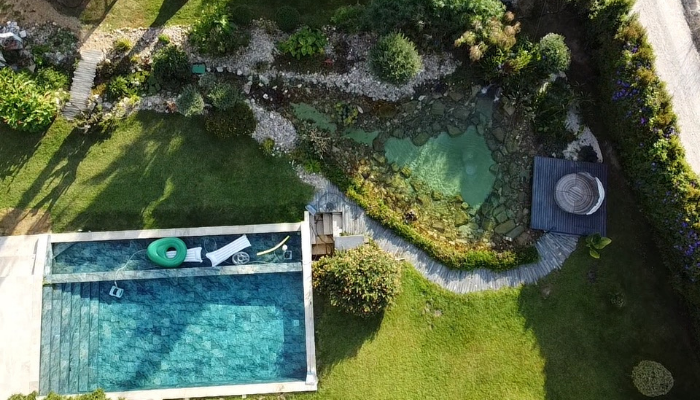
Water circulates continuously between two zones:
Swimming zone (40-60% of total area): Clear, deep water (1.5-3 meters typical) free of plants, designed for swimming, diving, and recreation.
Regeneration zone (40-60% of total area): Shallow planted wetland (0.3-0.8 meters depth) filled with aquatic plants (Phragmites, Typha, Juncus, Iris, submerged oxygenators) growing in gravel substrate.
Biological filtration process:
- Water flows from swimming zone into regeneration zone via gravity or pump
- Beneficial bacteria colonizing plant roots and gravel surfaces decompose organic matter (skin cells, oils, pollen)
- Nitrifying bacteria convert ammonia → nitrite → nitrate through aerobic processes
- Plants absorb nitrate as fertilizer, removing nitrogen permanently from water
- Gravel substrate filters particulates and provides massive surface area for bacterial colonization
- Purified water returns to swimming zone
Result: Crystal-clear water maintained through natural ecological processes, similar to clean natural lakes.
Natural Pool Components
Required infrastructure:
- Waterproof swimming zone (concrete, liner, or clay)
- Waterproof regeneration zone (gravel-filled basin with planted wetland)
- Circulation pump (low-power, runs continuously)
- Skimmer to remove floating debris
- Optional: UV clarification system for rapid startup or backup clarity assurance
No chemical equipment: No chlorinators, salt cells, chemical feeders, or testing kits required.
What is a Saltwater Pool?
Saltwater pools automate chlorine production through electrolysis but still use chlorine as the primary sanitizer.
How Saltwater Pools Work
Salt (sodium chloride) dissolved in pool water at 3,000-5,000 ppm passes through a salt chlorine generator (salt cell) with titanium electrode plates. Electrical current causes electrolysis, splitting salt molecules into sodium and chlorine. Chlorine dissolves into water as hypochlorous acid. It’s the same sanitizing compound used in traditional chlorine pools. It kills bacteria and algae. After sanitizing, chlorine recombines with sodium to form salt again, creating a continuous cycle.
Result: Automated chlorine production maintaining 1-3 ppm chlorine concentration without manual chlorine addition.
Saltwater Pool Components
Required infrastructure:
- Standard pool structure (any material)
- Salt chlorine generator: €1,200-2,400
- Salt dissolved in water: €40-100 initially
- Titanium electrode cell: €300-600 replacement every 3-7 years
- Chemistry testing equipment
- pH reducer (electrolysis raises pH naturally)
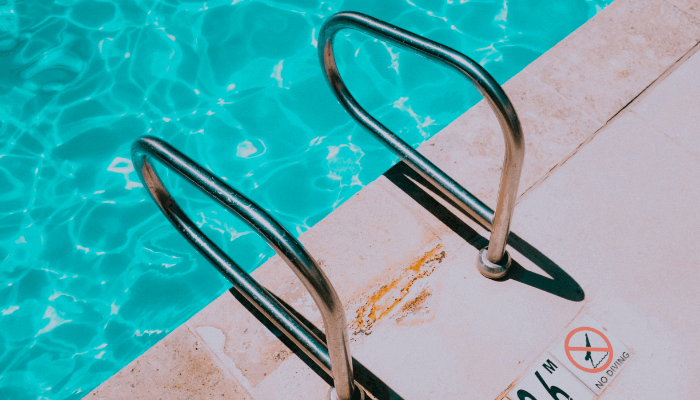
Important clarification: Saltwater pools are NOT chlorine-free. They produce chlorine automatically. They’re automatic chlorine generators, not chemical-free systems.
Cost Comparison
Initial Investment
Natural pool:
- Excavation and shaping (two zones): €15,000-25,000 (varies by size, site complexity)
- Waterproofing (liner or concrete): €8,000-15,000
- Gravel substrate for regeneration zone: €2,000-4,000
- Plants (4-6 per m²): €1,500-3,000
- Circulation pump and plumbing: €1,500-2,500
- Skimmer, overflow system: €500-1,000
- Total: €30,000-55,000 for residential natural pool (100-200 m² total area)
Saltwater pool:
- Base pool construction: €20,000-40,000 (standard chlorine pool cost)
- Salt chlorine generator and installation: €1,500-2,900
- Initial salt: €40-100
- Total: €21,500-43,000 for saltwater pool (same size swimming area as natural pool’s swimming zone)
Comparison: Natural pools cost 30-40% more initially due to larger total footprint (regeneration zone adds space) and biological infrastructure. However, for equivalent total water surface area, costs are comparable.
Annual Operating Costs
Natural pool:
- Electricity (low-power pump): €80-150 annually
- Replacement plants (occasional): €50-100 annually
- Pump maintenance: €50-100 annually
- Total: €180-350 annually
- No chemicals needed
Saltwater pool:
- Electricity (pump + generator): €150-300 annually
- Replacement salt: €30-60 annually
- pH reducer (muriatic acid): €20-40 annually
- Chemistry testing supplies: €20-40 annually
- Total: €220-440 annually
Comparison: Similar annual costs. Natural pools save on chemicals but use similar electricity. Neither requires expensive chemical purchases like traditional chlorine pools (€300-800 annually).
Long-Term Equipment Costs
Natural pool:
- Pump replacement: Every 8-12 years (€800-1,200)
- Plant replacement: Occasional (€100-300 every few years)
- Gravel topping: Every 10-15 years (€500-1,000)
Saltwater pool:
- Salt cell replacement: Every 3-7 years (€300-600)
- Pump replacement: Every 8-12 years (€600-1,000)
Maintenance Comparison
Natural Pool Maintenance
Weekly (10-15 minutes):
- Skim floating debris from swimming zone
- Net fallen leaves from regeneration zone if necessary
- Visual check of water clarity
Monthly (30-45 minutes):
- Remove accumulated organic debris from regeneration zone floor
- Check pump operation
- Inspect plants for health
Quarterly/Seasonal (2-4 hours):
- Trim overgrown plants (spring and autumn)
- Thin plants if overly dense
- Remove dead plant material before winter
- Clear accumulated sediment from regeneration zone (annually)
Annual deep maintenance (1 day):
- Drain and clean swimming zone (every 3-5 years, not annually)
- Remove excess organic accumulation from regeneration zone gravel
- Divide and replant overgrown plant clusters
Total time: 4-8 hours quarterly for routine maintenance, plus 1 day every 3-5 years for deep cleaning.
No chemical testing or balancing required.
Saltwater Pool Maintenance
Daily (5 minutes):
- Skim surface debris
- Check generator display for errors
Weekly (30-45 minutes):
- Test pH, chlorine, alkalinity
- Add pH reducer as needed (weekly or bi-weekly)
- Vacuum pool floor
- Brush walls
- Shock pool (weekly or bi-weekly)
Monthly (1-2 hours):
- Test salt level, calcium hardness, stabilizer
- Inspect salt cell for scaling
- Deep clean filter
Quarterly (2-3 hours):
- Deep clean salt cell (muriatic acid soak)
- Inspect equipment
- Test extended chemistry
Total time: 30-60 minutes monthly for routine maintenance, plus 2-3 hours quarterly for salt cell cleaning.
Chemistry testing and adjustment required throughout the swimming season.
Water Quality and Swimming Experience
Natural Pool Experience
Water feel: Soft, fresh water similar to swimming in a clean mountain lake. No chemical smell, taste, or sensation.
Clarity: 1-3 meter visibility when properly maintained. Water may have a slight natural tint (greenish or brownish) from tannins.This is normal and harmless, like natural lakes.
Temperature: No chemical heating constraints. Can be heated if desired, though many natural pool enthusiasts prefer unheated for authenticity.
Safety: Biological filtration eliminates bacteria and harmful microorganisms effectively. Regular testing is not required, but water should be tested initially and if problems are suspected.
Wildlife: Regeneration zone attracts beneficial insects (dragonflies), amphibians (frogs), and birds. The swimming zone remains clear of wildlife when properly designed with separation.
Allergies: Ideal for people with chlorine sensitivity, skin conditions (eczema, psoriasis), or chemical sensitivities.
Saltwater Pool Experience
Water feel: Soft, silky texture due to salt. Gentler than traditional chlorine pools but still contains chlorine (1-3 ppm).
Clarity: Crystal clear when properly maintained. No natural coloration.
Temperature: Can be heated without restriction. Salt-compatible heaters required (titanium or cupro-nickel heat exchangers).
Safety: Chlorine effectively sanitizes water. Safe for swimming when chemistry is balanced.
Chemical exposure: Lower chlorine than traditional pools (1-3 ppm vs. 3-5 ppm). Less eye/skin irritation but not chemical-free.
Allergies: Better for sensitive individuals than traditional chlorine pools, but chlorine still present. Not suitable for severe chlorine allergies.
Environmental Considerations
Natural Pool Environmental Impact
Positives:
- Zero chemical discharge into environment
- Creates wildlife habitat (regeneration zone supports biodiversity)
- Carbon sequestration through plant growth
- Water safe for irrigation after overflow (no harmful chemicals)
- Minimal energy consumption (low-power pump only)
- Integrates with natural landscape
Considerations:
- Larger footprint requires more space
- Plants increase evaporation (20-30% more than open water)
- Occasional need to thin/remove excess plant material
Verdict: Highly eco-friendly, supports the local ecosystem.
Saltwater Pool Environmental Impact
Positives:
- Lower chlorine concentration than traditional pools (reduced chemical exposure)
- Automated chlorine generation eliminates packaging/transportation of chlorine products
- Salt is natural mineral requiring minimal processing
Negatives:
- Chlorine still discharged during backwashing
- Higher electricity consumption (salt generator)
- Salt water toxic to plants (avoid splash onto landscaping)
- Backwash water high in salt (dispose per local regulations)
Verdict: More eco-friendly than traditional chlorine pools but still chemical-dependent.
Aesthetic and Landscape Integration
Natural Pool Aesthetics
Appearance: Resembles natural pond with planted edges. Swimming zones can be formal (geometric) or organic (curved, naturalistic). Regeneration zone designed as wetland garden with flowering plants, grasses, and aquatic vegetation.
Landscape integration: Blends seamlessly with gardens, natural landscapes, rural properties. Attracts wildlife, creating dynamic, living water features.
Design flexibility: Highly customizable. Can mimic mountain ponds, lowland wetlands, formal water gardens, or contemporary installations with clean lines and architectural planting.
Materials: Natural stone, wood, gravel typical. Can incorporate contemporary materials (concrete, steel) for modern designs.
Visual appeal: Changes with seasons. In spring there is flowering, in summer lushness, in autumn seed heads, in winter structure. Provides year-round interest.
Saltwater Pool Aesthetics
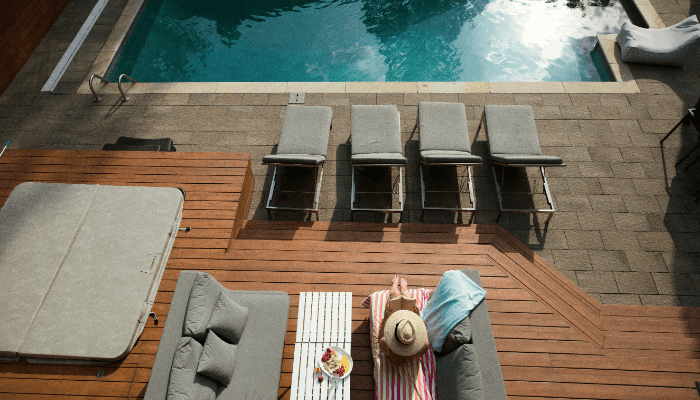
Appearance: Conventional swimming pool like rectangular, kidney-shaped, or freeform. Clear blue water, hard edges (tile, coping), surrounding deck.
Landscape integration: Separate from landscape; requires deck/hardscaping surrounding pool. Integration achieved through adjacent planting, not pool itself.
Design flexibility: Standard pool shapes and finishes. Aesthetics are determined by coping, decking, and surrounding landscape, not pool systems.
Materials: Concrete, fiberglass, vinyl liner. Tile, stone, or concrete coping. Surrounding deck (concrete, pavers, stone).
Visual appeal: Static, controlled appearance. Consistent year-round.
Climate Suitability: Portugal Considerations
Natural Pools in Portugal
Advantages:
- The Mediterranean climate is ideal for aquatic plants. You have year-round growth, and no winter die-back in most regions.
- Mild winters eliminate freeze concerns (plants survive outdoors).
- Hot, dry summers provide excellent growing conditions.
- Native Portuguese aquatic plants available (Typha, Phragmites, Juncus, Iris pseudacorus).
- The long swimming season (May-October) maximizes pool use.
Considerations:
- Summer heat increases evaporation (add water more frequently).
- Occasional drought requires irrigation of the regeneration zone during extreme dry spells.
- Spring pollen may temporarily affect water clarity (clear naturally within days).
Saltwater Pools in Portugal
Advantages:
- Mild winters mean year-round operation possible (no winterization required unlike northern climates)
- Hot summers favor swimming, though generator runs longer hours (10-12 daily vs. 6-8)
- Electricity costs moderate compared to northern Europe
Considerations:
- Hard water (common in Portugal) accelerates salt cell scaling. Clean it every 2-3 months instead of quarterly.
- Summer heatwaves can push water temperature above 28°C (reduce feeding, increase aeration).
- Salt corrosion accelerated by coastal proximity in Algarve and Atlantic coast regions.
Which System is Right for You?
Choose Natural Pool If:
- You want completely chemical-free swimming
- You value ecological benefits and wildlife habitat
- You have space for larger footprint (regeneration zone)
- You appreciate naturalistic aesthetics and seasonal change
- You prefer minimal long-term maintenance (no chemistry testing)
- You have chlorine sensitivity or skin conditions aggravated by chemicals
- You want pool to integrate seamlessly with garden or natural landscape
Choose Saltwater Pool If:
- You prefer conventional pool aesthetics
- You have limited space (no room for regeneration zone)
- You want automated sanitation with minimal manual intervention
- You’re comfortable with low-level chlorine exposure (gentler than traditional chlorine)
- You prefer crystal-clear, consistently blue water year-round
- You want ability to heat pool without restriction
- Initial budget doesn’t accommodate 30-40% natural pool premium
Common Misconceptions
Myth: Natural pools are dirty or unsafe
Reality: Properly designed natural pools achieve excellent water quality through biological filtration. Bacterial counts are typically lower than swimming in rivers or lakes. Clear water, effective pathogen removal, safe for all ages.
Myth: Saltwater pools are chlorine-free
Reality: Saltwater pools produce chlorine via electrolysis. They are automatic chlorine generators, not chemical-free systems. Chlorine concentration (1-3 ppm) is lower than traditional pools but still present.
Myth: Natural pools require no maintenance
Reality: Natural pools require different maintenance than chemical pools—seasonal plant care, debris removal, occasional sediment clearing. Less frequent than weekly chemistry testing but not zero maintenance.
Myth: Saltwater pools don’t require chemicals
Reality: Saltwater pools require pH reducer (electrolysis raises pH), stabilizer, and occasional shock treatments. Chemical load is lower than traditional chlorine pools but not eliminated.
Myth: Natural pools are always green and murky
Reality: Well-maintained natural pools achieve 1-3 meter clarity. Slight natural tint possible from tannins (like forest streams) but water remains transparent. Murkiness indicates poor design or maintenance, not inherent natural pool characteristics.
Conclusion
Natural pools and saltwater pools serve different priorities. Natural pools eliminate all chemical sanitizers through biological filtration via aquatic plants and beneficial bacteria, creating chemical-free swimming environments that integrate seamlessly with natural landscapes. Initial costs are 30-40% higher than conventional pools, but ongoing chemical costs are zero, and maintenance focuses on seasonal plant care rather than weekly chemistry testing.
Saltwater pools automate chlorine production through salt electrolysis, reducing but not eliminating chemical exposure. Initial costs exceed traditional chlorine pools by €1,500-2,900 for generator equipment, but annual chemical costs (€110-320) are significantly lower than traditional chlorine pools. Maintenance requires monthly chemistry testing and salt cell cleaning but less hands-on work than manual chlorine addition.
Portugal’s Mediterranean climate favors both systems: year-round biological activity supports natural pool plants, while mild winters allow saltwater pools to operate continuously without winterization. The choice depends on priorities = chemical-free swimming and ecological integration versus automated conventional sanitation with familiar pool aesthetics.
For those seeking truly chlorine-free swimming integrated with natural landscapes, Oásis Biosistema designs natural pools optimized for Portugal’s climate with appropriate plant species selection and biological filtration sizing.
FAQ
What’s better, a saltwater pool or a regular pool?
Saltwater pools offer softer-feeling water and more consistent chlorine levels, making them more comfortable for many swimmers. Regular chlorine pools are cheaper to install and simpler to repair. The better option depends on budget, maintenance preference, and sensitivity to chemicals rather than overall performance.
What pool system is best for eczema?
Saltwater or mineral pool systems are often best for eczema because they maintain lower, steadier chlorine levels and feel gentler on sensitive skin. Adding UV or ozone systems can further reduce irritation, but proper water balance and cleanliness are essential to prevent flare-ups.
What is the downside of a salt water pool?
Saltwater pools have higher upfront costs and can cause corrosion to metal fixtures, pool equipment, and nearby surfaces. The salt chlorinator cell also requires maintenance and eventual replacement. While easier to manage, they still rely on balanced chemicals and ongoing upkeep.
Can chlorine in a pool cause a sore throat?
Yes, chlorine can cause a sore throat, especially if levels are too high or poorly balanced. Chloramines, formed when chlorine reacts with contaminants, can irritate the throat, eyes, and lungs. Proper ventilation and balanced water chemistry help reduce irritation and improve swimmer comfort.