A regeneration zone is a planted wetland area in natural swimming pools that functions as a biological filtration system, using aquatic plants and beneficial bacteria to purify water without chemicals. Typically occupying 40-60% of total pool area, the regeneration zone features shallow water (30-80 cm depth) planted with emergent aquatic species (Typha, Phragmites, Juncus, Iris) rooted in gravel substrate where bacteria colonize. Water circulates continuously from the swimming zone through the regeneration zone, where plants absorb nutrients like nitrogen and phosphorus while bacteria break down organic matter, returning crystal-clear water to the swimming area.
This comprehensive guide covers regeneration zone design principles, sizing requirements, plant selection for different climates, gravel substrate specifications, water circulation systems, biological filtration mechanisms (nitrification, denitrification, nutrient uptake), maintenance requirements, seasonal care, and comparison with conventional pool filtration. Understanding regeneration zones enables appreciation of how natural pools achieve chemical-free water clarity through ecosystem principles.
Key Takeaways
- Regeneration zone = biological filter – planted wetland purifies water through natural processes
- Size: 40-60% of total pool area – equal or larger than swimming zone for adequate filtration capacity
- Depth: 30-80 cm (12-32 inches) – shallow water optimal for plant growth, bacterial activity
- Gravel substrate essential – provides surface area for beneficial bacteria colonization (not sand)
- Plant diversity critical – emergent, submerged, floating plants perform different filtration functions
- Continuous circulation required – water pumped through regeneration zone every 6-24 hours
- Zero chemicals needed – plants and bacteria eliminate need for chlorine, salt, or sanitizers
- Visibility: 1-3 meters typical – biological filtration maintains crystal-clear water year-round
What Is a Regeneration Zone?
A regeneration zone (also called bog filter, planted filter, or constructed wetland) is a shallow planted wetland integrated into a natural swimming pool that performs biological water treatment. Unlike conventional pool filters that trap particles mechanically, regeneration zones purify water biologically – plants absorb dissolved nutrients, bacteria decompose organic matter, and natural processes eliminate pathogens.
How It Differs from Conventional Filtration
Conventional pool filtration:
- Mechanical filter (sand, cartridge, DE) traps suspended particles
- Chemical sanitizer (chlorine, bromine, salt) kills bacteria, algae
- Requires daily chemical monitoring, weekly shocking
- Produces chemical smell, can irritate skin/eyes
- Ongoing chemical costs €200-500 annually
Regeneration zone filtration:
- Living ecosystem filters water biologically
- Plants absorb nutrients that would feed algae
- Bacteria convert ammonia → nitrate (harmless)
- Zero chemical sanitizers or testing
- Minimal operating cost (electricity for pump only)
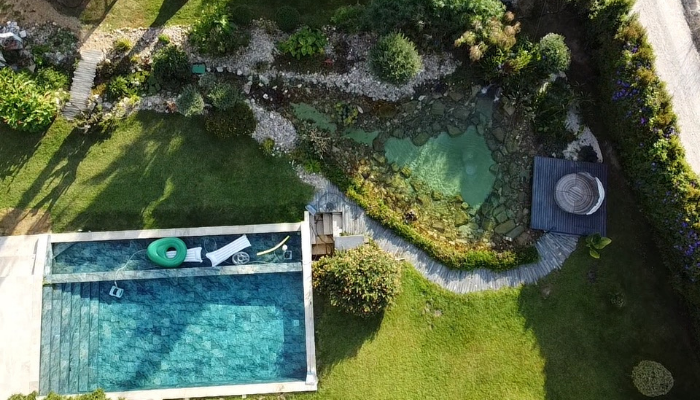
Two-Zone Pool Design
Swimming zone (40-50% of pool area):
- Deep water (120-200 cm typical)
- Plant-free clear area for swimming
- Smooth liner or natural bottom
- Visually separated from regeneration zone by underwater wall or edge
Regeneration zone (50-60% of pool area):
- Shallow water (30-80 cm)
- Densely planted wetland
- Gravel substrate (not sand)
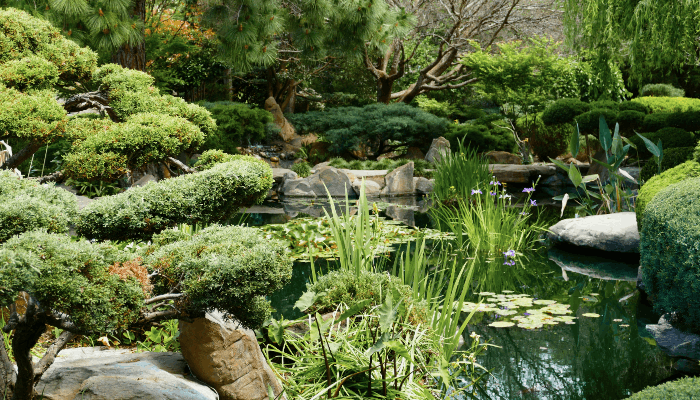
- Visually integrated into landscape as water garden
Separation: Physical barrier (underwater wall, shelf edge) prevents swimmers entering the regeneration zone while allowing water to flow between zones via pump circulation.
How Regeneration Zones Work: Biological Filtration
Three Filtration Processes
1. Nutrient Absorption by Plants
What happens: Aquatic plants absorb dissolved nutrients (nitrogen, phosphorus) from water through roots and leaves.
Why it matters: These same nutrients fuel algae growth in conventional pools. By absorbing nutrients, plants starve algae, preventing green water without algaecides.
Key nutrients removed:
- Nitrate (NO₃⁻): Primary nitrogen source for plants, absorbed by roots
- Phosphate (PO₄³⁻): Absorbed by roots, stored in plant tissues
- Ammonium (NH₄⁺): Directly absorbed by some aquatic plants
Continuous removal: Growing plants continuously remove nutrients. Seasonal plant harvesting (cutting back dead foliage) physically removes nitrogen and phosphorus from system permanently.
2. Bacterial Decomposition (Nitrification/Denitrification)
Nitrification: Aerobic bacteria (Nitrosomonas, Nitrobacter) colonizing gravel surfaces and plant roots convert toxic ammonia from swimmer pollutants (sweat, skin cells, urine) → nitrite → nitrate.
Denitrification: Anaerobic bacteria in deeper substrate layers convert nitrate → nitrogen gas (N₂) which escapes to atmosphere, completing nitrogen removal.
Where bacteria live: Gravel substrate provides enormous surface area for bacterial colonization. Plant roots create oxygen-rich zones (supporting nitrifying bacteria) adjacent to oxygen-poor zones (supporting denitrifying bacteria).
Continuous cycle: Bacteria work 24/7 converting pollutants, maintaining water chemistry without chemical additions.
3. Physical Filtration and Pathogen Reduction
Physical processes:
- Sedimentation: Particles settle in calm vegetated areas
- Filtration: Plant stems, roots strain fine particles from water
- Adsorption: Organic particles stick to plant surfaces, gravel
Pathogen reduction:
- Long retention time in regeneration zone (water flows slowly through plants)
- Competition from beneficial bacteria outcompetes harmful bacteria
- UV exposure in shallow water
- Plant root exudates (substances released by roots) have antimicrobial properties
- Predation by zooplankton, microorganisms
Result: Pathogen levels comparable to or lower than chlorinated pools, without chemical sanitizers.
Regeneration Zone Design Requirements
Sizing: 40-60% of Total Pool Area
General guideline: Regeneration zone should equal or exceed swimming zone surface area.
Examples:
- Swimming zone 50 m² → Regeneration zone 50-60 m² minimum
- Swimming zone 30 m² → Regeneration zone 30-40 m² minimum
- Total pool footprint typically 1.5-2x the desired swimming area
Why so large: Adequate plant biomass and gravel surface area necessary for biological filtration capacity to process swimmer pollutants. Undersized regeneration zones can’t keep up with organic load, resulting in murky water, algae blooms.
Exceptions:
- Low use pools (occasional swimming): Can use smaller ratio 30-40% regeneration zone
- High use pools (daily swimming, many users): May require larger ratio 60-70% regeneration zone
- Advanced biofilm filters: Compact engineered systems can reduce regeneration zone to 10-20% of pool area but sacrifice natural aesthetic
Depth: 30-80 cm (12-32 inches)
Optimal depth for plant growth: Most emergent aquatic plants (cattails, rushes, reeds) root best in 30-60 cm water depth.
Bacterial activity: Shallow water maintains warmer temperatures than deep water, accelerating bacterial metabolism, nutrient processing.
Oxygen penetration: Shallow water allows oxygen to reach substrate more effectively, supporting aerobic bacteria essential for ammonia conversion.
Depth variation acceptable: Regeneration zones can include varying depths (20 cm shallow margins, 60-80 cm deeper areas) accommodating different plant species, creating diverse microhabitats.
Gravel Substrate: Not Sand
Gravel essential: Provides surface area for bacterial colonization (biofilm). Bacteria living on gravel surfaces perform nitrification converting ammonia → nitrate.
Gravel size: 10-30 mm diameter typical. Too fine (sand) compacts, restricts water flow, becomes anaerobic. Too coarse (> 50 mm) provides insufficient surface area.
Depth: 30-40 cm gravel layer typical, providing volume for bacterial colonization, plant root anchorage.
Why not sand: Sand compacts, clogs, restricts water and oxygen flow. Anaerobic conditions develop, producing toxic hydrogen sulfide (rotten egg smell). Gravel’s open structure maintains flow, oxygen penetration.
Washed gravel: Must be clean, free of sediments, dust. Unwashed gravel clouds water initially.
Plant Selection for Regeneration Zones
Plant Categories and Functions
Emergent Plants (Rooted, Stems/Leaves Above Water)
Function: Primary nutrient absorption through extensive root systems, structural support for bacterial colonization, visual softening of pool edge.
Examples:
Cattails (Typha latifolia, Typha angustifolia): Fast-growing, aggressive nutrient absorbers. Spread via rhizomes – requires containment or regular division. Native to Portugal, cold-hardy, thrives in full sun.
Common Reed (Phragmites australis): Tall (2-4 meters), excellent nutrient uptake. Can be invasive – plant sterile cultivars or contain roots. Native throughout Europe.
Rushes (Juncus effusus, Juncus inflexus): Clumping growth, less aggressive than cattails. Attractive vertical form. Cold-hardy, tolerates partial shade.
Water Iris (Iris pseudacorus, Iris versicolor): Beautiful yellow flowers (spring), moderate nutrient uptake. Less aggressive than cattails/reeds. Native I. pseudacorus suitable for Portugal.
Depth: Plant in 20-60 cm water depth depending on species.
Submerged Plants (Entirely Underwater)
Function: Oxygenate water through photosynthesis, absorb nutrients directly from water column, provide habitat for beneficial microorganisms.
Examples:
Hornwort (Ceratophyllum demersum): Free-floating (no roots), absorbs nutrients through leaves, produces oxygen. Can become prolific – requires thinning.
Water Milfoil (Myriophyllum): Feathery foliage, excellent oxygenator. Plant in pots to contain spread.
Canadian Waterweed (Elodea canadensis): Aggressive oxygenator, cold-tolerant. Provides fish/amphibian habitat.
Depth: Can grow in 30-200 cm water depth and is typically planted in deeper areas of the regeneration zone.
Floating Plants (Roots in Water, Leaves on Surface)
Function: Shade water surface (reduces algae by blocking light), absorbs nutrients through dangling roots.
Examples:
Water Lettuce (Pistia stratiotes): Tropical, not frost-hardy. Remove before first frost in temperate climates. Aggressive spreader.
Water Hyacinth (Eichhornia crassipes): Beautiful purple flowers, prolific nutrient absorber. Tropical – not winter-hardy in Portugal. Can be invasive in frost-free regions.
Duckweed (Lemna minor): Tiny floating plant, covers surface rapidly. Effective nutrient absorber but difficult to control once established.
Use sparingly: Excessive floating plants block light needed by submerged plants, reduce oxygen exchange at surface.
Climate Considerations for Portugal
Mediterranean climate (hot dry summers, mild wet winters):
Advantages:
- Year-round biological activity (bacteria, plants active even in winter)
- No winter ice damage to plants or infrastructure
- Long growing season maximizes nutrient uptake
Suitable plants:
- Typha latifolia (cattail): Thrives in full sun, tolerates drought
- Phragmites australis (common reed): Native, adapted to Mediterranean conditions
- Juncus species (rushes): Tolerates seasonal water level fluctuations
- Iris pseudacorus (yellow flag iris): Native, beautiful spring flowers
- Schoenoplectus lacustris (bulrush): Tolerates warm water
Avoid:
- Tropical species without winter protection (Canna, Taro)
- Species requiring consistent cold dormancy (some temperate bog plants)
Water Circulation System
Pump Requirements
Function: Circulate water continuously from swimming zone → through regeneration zone gravel/plant roots → back to swimming zone.
Flow rate: Complete water volume exchange every 6-24 hours typical.
- Example: 60 m³ (60,000-liter) pool → 2,500-10,000 liters/hour pump capacity
Pump type:
- Submersible pump in swimming zone or regeneration zone
- External pump at equipment area
- Energy-efficient variable-speed pump preferred (reduces electricity costs)
Intake location: Swimming zone (extracts swimmer pollutants for treatment).
Return location: Can return to the swimming zone via underwater jets, or via waterfall/stream feature creating visual interest.
Flow Distribution
Even distribution critical: Water must flow evenly through entire regeneration zone gravel bed, not short-circuit through preferential paths.
Design strategies:
- Perforated distribution pipe buried in gravel (spreads incoming water)
- Multiple inlet points across regeneration zone width
- Gravel bed sloped slightly toward collection point ensuring flow through entire bed
Monitoring: Observe plant health – plants in poorly circulated areas show nutrient deficiency (yellowing), indicating dead zones in flow pattern.
Optional: Skimmer and Pre-Filter
Skimmer: Removes floating debris (leaves, insects) before entering the regeneration zone, reducing organic load on biological filters.
Pre-filter (optional): Mechanical filter (foam, screen) removes large particles before the regeneration zone. Reduces maintenance but adds complexity.
Oásis Biosistema designs optimize circulation patterns for maximum biological efficiency while maintaining aesthetic integration of regeneration zones into landscape design.
Seasonal Maintenance
Spring (March-May)
Plant activation: As water warms (above 10°C), plant growth resumes. Bacterial activity increases exponentially as temperature rises.
Tasks:
- Remove dead plant material from previous season (standing cattail/reed stems)
- Divide overcrowded plants (cattails, rushes spread aggressively)
- Add new plants to fill gaps from winter losses
- Check pump, clean intake screen
- Start pump circulation (if stopped over winter)
Time required: 2-4 hours for a typical 50 m² regeneration zone.
Summer (June-September)
Peak biological activity: Maximum plant growth, nutrient absorption. Bacteria are most active at warm temperatures (20-25°C optimal).
Tasks:
- Monitor plant growth – thin overcrowded areas (maintain 60-70% coverage, not 100%)
- Remove excess floating plants (duckweed, water lettuce) if coverage exceeds 30% of surface
- Check for algae in swimming zone (indicates undersized regeneration zone or pump malfunction)
- Monitor water clarity (should maintain 1-3 meter visibility)
Time required: 1-2 hours monthly inspection.
Autumn (October-November)
Plant dieback: Deciduous plants (cattails, reeds) die back naturally. Cut stems remain standing over winter – provide wildlife habitat, visual interest.
Tasks:
- Optional: Cut back dead cattail/reed stems to 15-20 cm above water (removes nutrients stored in foliage, but not required)
- Remove fallen leaves from pool surface before they sink (leaf net cover useful)
- Reduce pump runtime if pool not in use (can run 4-6 hours daily instead of 12-24 hours)
Time required: 2-3 hours for seasonal cutback (if chosen).
Winter (December-February)
Dormancy (in temperate climates): Plants dormant, bacterial activity slowed but not stopped. In Portugal’s mild climate, the regeneration zone continues functioning at reduced capacity.
Tasks:
- Minimal – system self-maintaining
- Check pump periodically (monthly) ensuring operation
- Remove any excessive debris accumulation
Time required: < 1 hour per month.
Note: In freezing climates (sustained temperatures below 0°C), ice forms on the regeneration zone surface. Plants overwinter beneath ice. The pump continues running to maintain circulation under ice.
Benefits of Regeneration Zone Filtration
Environmental Benefits
Zero chemical discharge: No chlorine, algaecides, or other chemicals entering the environment when draining/backwashing pool.
Wildlife habitat: Regeneration zones support biodiversity – frogs, dragonflies, beneficial insects, birds. Creates ecological value beyond swimming function.
Carbon sequestration: Growing plants absorb CO₂, store carbon in biomass.
Water conservation: Natural pools lose water only to evaporation, plant transpiration. No backwashing waste like conventional filters.
Health Benefits
No chemical exposure: Swimmers avoid chlorine, chloramines (causing red eyes, dry skin, respiratory irritation), bromide compounds.
Soft natural water: Feels silky, gentle on skin. No chlorine smell, no bleached swimsuits.
Safe for sensitive individuals: Children, people with chemical sensitivities, asthma, eczema often tolerate natural pools better than chlorinated pools.
Economic Benefits
Lower operating costs: Electricity for pump only (€100-300 annually). No chemicals (saves €200-500+ annually vs. conventional pool).
Lower maintenance time: No daily chemical testing, shocking, algaecide additions. Seasonal plant maintenance only.
Property value: Natural pools enhance landscape aesthetics, appeal to environmentally conscious buyers, and differentiate property from conventional pool installations.
Challenges and Considerations
Space Requirements
Challenge: Regeneration zone requires 50-100% additional space beyond desired swimming area.
Example: Want 40 m² swimming area → Need 80-100 m² total property dedicated to pool (swimming + regeneration zones).
Solution: For limited space, consider compact wetland filter (engineered planted filter box) reducing footprint to 10-20% of swimming area, or biofilm filter (no plants) further reducing size. Sacrifices natural aesthetic but maintains biological filtration.
Initial Cost
Higher upfront investment: Natural pools cost €300-500 per m² total pool area (swimming + regeneration), approximately 20-40% more than conventional pool installation.
Cost breakdown:
- Excavation (larger total footprint)
- Liner or waterproofing for both zones
- Gravel substrate (30-40 cm depth × regeneration zone area)
- Plants (initial planting density 5-10 plants per m²)
- Pump and circulation infrastructure
- Landscaping integration
Long-term savings offset: Lower operating costs (no chemicals, less maintenance) recover premium over 5-10 years.
Aesthetic Adaptation
Challenge: Regeneration zone has “wild” planted aesthetic, not sterile blue rectangle of conventional pool.
Some find it beautiful: Water garden appearance, seasonal changes, wildlife presence.
Others find it less formal: Prefer clean geometric pool aesthetics.
Solution: Design regeneration zone intentionally – can create formal planted borders, architectural edges, controlled plant palette matching landscape style. Not necessarily a “wild pond” – it can be an elegant water garden.
Water Clarity Expectations
Realistic expectations: Natural pools maintain 1-3 meter visibility (crystal clear) but water may have a slight natural tint (tea-colored from tannins, slight green from algae). Not the artificial blue of chlorinated pools.
Clarity influenced by:
- Regeneration zone size (larger = clearer)
- Plant density and health
- Swimmer load (more swimmers = more pollutants)
- Maintenance consistency
Comparison: Regeneration Zone vs. Conventional Filtration
Filtration Mechanism
Conventional: Mechanical filter traps particles, chemical sanitizer kills organisms.
Regeneration zone: Living ecosystem absorbs nutrients, decomposes organics biologically.
Operating Costs
Conventional: €200-500 annually (chemicals, filter media replacement, occasional equipment repairs).
Regeneration zone: €100-300 annually (pump electricity only).
Maintenance Time
Conventional: 1-2 hours weekly (skimming, vacuuming, chemical testing, adjustments).
Regeneration zone: 1-2 hours weekly (skimming, vacuuming) + 4-8 hours seasonally (plant care).
Water Quality
Conventional: Sterile, chemically sanitized, artificial blue color, chlorine smell.
Regeneration zone: Biologically balanced, natural appearance, no chemical odor, soft feel.
Environmental Impact
Conventional: Chemical discharge, energy for chlorination/heating, synthetic materials.
Regeneration zone: Zero chemical discharge, moderate energy (pump only), habitat creation.
Conclusion
Regeneration zones are shallow planted wetlands integrated into natural swimming pools that purify water biologically without chemicals, typically occupying 40-60% of total pool area with depth 30-80 cm and gravel substrate supporting aquatic plants (Typha, Phragmites, Juncus, Iris) and beneficial bacteria. Water circulates continuously from swimming zone through regeneration zone where three processes occur simultaneously: plants absorb dissolved nutrients (nitrogen, phosphorus) that would otherwise fuel algae growth, nitrifying bacteria colonizing gravel surfaces convert toxic ammonia from swimmer pollutants into harmless nitrate through aerobic decomposition, and anaerobic bacteria in deeper substrate layers convert nitrate to nitrogen gas completing nutrient removal cycle.
Design requirements include adequate sizing with regeneration zone equal to or larger than swimming zone to provide sufficient biological filtration capacity (undersized zones result in murky water and algae blooms), shallow depth optimal for plant growth and bacterial activity, washed gravel substrate 10-30 mm diameter providing massive surface area for bacterial colonization unlike sand which compacts and restricts oxygen flow, diverse plant selection combining emergent species for nutrient absorption, submerged species for oxygenation, and minimal floating species for surface shading, and continuous water circulation via pump completing full volume exchange every 6-24 hours distributing water evenly through entire gravel bed.
Seasonal maintenance requires spring activation removing dead plant material and dividing overcrowded plants (2-4 hours), summer monitoring thinning excess growth and maintaining 60-70% plant coverage (1-2 hours monthly), autumn optional cutback of deciduous plants removing nutrients stored in dying foliage (2-3 hours), and winter minimal intervention as system continues functioning at reduced capacity in Portugal’s mild Mediterranean climate where year-round biological activity occurs unlike freezing climates where ice forms but regeneration zones overwinter successfully beneath ice. Benefits include zero chemical exposure creating soft natural water safe for sensitive swimmers, lower operating costs of €100-300 annually versus €200-500 for conventional chemical pools, enhanced biodiversity supporting wildlife habitat and carbon sequestration, and aesthetic value integrating water garden into landscape design, though challenges include larger space requirements, 20-40% higher initial installation costs, and adaptation to natural planted aesthetic rather than formal geometric pool appearance.
FAQ
What is a regeneration zone?
A regeneration zone is an area targeted for renewal and improvement, often through new housing, infrastructure, businesses, or public spaces. These projects aim to revive underused or declining neighborhoods and boost economic and social activity.
What does it mean to regenerate an area?
To regenerate an area means to improve and redevelop it. This can include renovating buildings, creating jobs, upgrading transport, and improving public spaces to make the area more attractive and functional.
What does regeneration mean in simple terms?
Regeneration means restoring or renewing something so it becomes stronger, healthier, or more useful again. It can apply to places, communities, nature, or even living tissue.
What does regeneration mean in housing?
In housing, regeneration refers to redeveloping residential areas by replacing or upgrading older homes, improving facilities, and creating better living conditions for residents. It often focuses on long-term community improvement.