Your backyard pool is a chemistry experiment.
Every week, you’re testing pH levels, adding chlorine, shocking the water, balancing alkalinity, and fighting an endless battle against algae. Your skin dries out. Your towels smell like a public pool. And you’re spending €500+ annually on chemicals just to maintain water that’s technically “clean” but feels increasingly toxic.
There’s a better way. One that’s been used in Europe for over 30 years but is only now gaining serious traction in Portugal.
Natural swimming pools use plants, beneficial bacteria, and natural filtration instead of chemicals to keep water clean and safe. No chlorine. No harsh sanitizers. Just living, balanced ecosystems that purify themselves through biological processes.
Estimates suggest there are around 20,000 natural swimming pools (public and private) in Europe, and numbers are growing especially in Germany, Austria, and Switzerland.
They’re sophisticated water systems that work as well or better than conventional pools while being gentler on skin, better for the environment, and often cheaper to operate long-term.
But here’s what most people don’t understand: a natural swimming pool isn’t just a pool with some plants around it. It’s a fundamentally different system that requires proper design, adequate space, and understanding of how biological filtration actually works.
Build it right, and you have crystal-clear water that stays clean year-round without chemicals. Build it wrong, and you have an expensive green pond that never quite works the way it should.
This guide explains exactly what natural swimming pools are, how they function, what they cost to build and maintain, how much space they actually require, and whether one makes sense for your Portuguese property. We’ll cover the engineering reality, not the marketing fantasy.
No greenwashing. No romantic notions about “swimming with nature.” Just practical information about creating a functional, beautiful, chemical-free swimming pool at your home.
Let’s start with what’s actually happening when plants clean your pool water.
Key Takeaways
- Natural pools use biological filtration instead of chemicals
- They require 30 to 50% more space than conventional pools for filtration zones
- Construction costs similar to quality conventional pools (€25,000–€80,000)
- Operating costs significantly lower due to no chemical purchases
- Water stays clean through plants, gravel beds, and beneficial bacteria
- Maintenance is different, not harder, than conventional pools
- Climate in Portugal is ideal for natural pool systems
- Not all properties have adequate space or conditions for natural pools
Build Natural Pools That Actually Work
What Is a Natural Swimming Pool?
A natural swimming pool is a self-sustaining aquatic ecosystem that uses biological filtration through plants, gravel beds, and beneficial bacteria to keep water clean instead of chemical sanitizers.
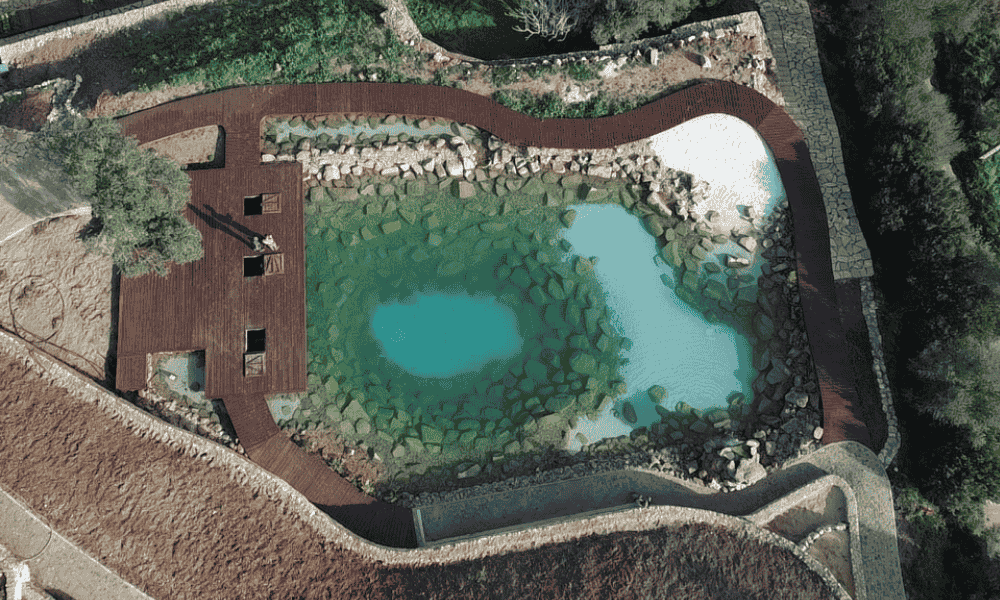
It consists of two main zones: the swimming area where people actually use the pool, and the regeneration zone where plants and microorganisms purify the water naturally.
How It Differs From Conventional Pools
Conventional pools:
- Rely on chlorine or salt sanitizers to kill bacteria
- Filter mechanically through sand or cartridge filters
- Require constant chemical balancing
- Water is sterile, devoid of life
- Need draining and refilling periodically
Natural pools:
- Use biological processes to break down contaminants
- Filter through planted gravel beds and beneficial bacteria
- Self-balance through ecosystem processes
- Water is alive with beneficial microorganisms
- Rarely need draining, system regenerates continuously
The fundamental difference is chemical sterilization versus biological balance.
The Two-Zone System
Swimming Zone (50–70% of total area):
This is where you actually swim. Looks like a conventional pool but with softer edges and natural materials. Water depth typically 1.2–2 meters.
Regeneration Zone (30–50% of total area):
Shallow planted area (usually 30–60cm deep) where aquatic plants and gravel beds filter the water. This is the biological treatment plant.
Water circulates between both zones continuously, getting cleaned as it passes through the regeneration area.
What Makes It “Natural”
- No chlorine or chemical sanitizers
- Plants provide oxygen and nutrient uptake
- Beneficial bacteria break down organic matter
- Natural materials (stone, gravel, clay liners)
- Ecosystem maintains itself through biological balance
- Wildlife (dragonflies, frogs) often establish naturally
Natural doesn’t mean low-tech. Modern natural pools use sophisticated pumps, filtration, and circulation systems. The difference is biology does the cleaning work instead of chemistry.
How Natural Swimming Pools Work
Understanding the process demystifies why they stay clean without chemicals.
The Biological Filtration Process
Step 1: Water Circulation
Pump moves water from the swimming zone to the regeneration zone. Continuous flow is essential.
Step 2: Plant Filtration
Aquatic plants in the regeneration zone absorb nutrients (nitrogen, phosphorus) that would otherwise feed algae. Roots provide surface area for beneficial bacteria colonization.
Step 3: Gravel Bed Filtration
Water passes through layers of gravel (various sizes) where beneficial bacteria colonize. These microorganisms break down organic matter, converting it to harmless compounds.
Step 4: Oxygen Exchange
Plants produce oxygen during photosynthesis. Well-oxygenated water supports beneficial bacteria and prevents anaerobic (harmful) bacteria growth.
Step 5: Return to Swimming Zone
Cleaned, oxygenated water flows back to the swimming area. The cycle repeats continuously.
The Role of Plants
Plants aren’t just decoration. They’re the workforce.
Nutrient uptake:
Plants consume nitrogen and phosphorus from decomposing leaves, swimmer waste, and other organics. This starves algae of food.
Oxygen production:
Photosynthesis adds oxygen to water, supporting beneficial bacteria and preventing stagnant conditions.
Habitat creation:
Plant roots provide enormous surface area where beneficial bacteria colonize and do filtration work.
Temperature regulation:
Plants shade portions of water, reducing excessive heating that promotes algae.
Common Plants Used
Emergent plants (stems above water):
- Reed (Phragmites australis)
- Cattail (Typha latifolia)
- Iris (Iris pseudacorus)
- Rush (Juncus species)
Submerged plants (underwater):
- Hornwort (Ceratophyllum demersum)
- Water milfoil (Myriophyllum species)
- Pondweed (Potamogeton species)
Floating plants:
- Water lily (Nymphaea species)
- Water lettuce (Pistia stratiotes)
Plant selection depends on climate, water depth, and aesthetic preferences. In Portugal, native Mediterranean aquatic species work best.
The Gravel Substrate
Multiple layers of gravel with different sizes create optimal bacteria colonization:
- Coarse gravel (20 to 40mm): Bottom layer, structural support
- Medium gravel (10 to 20mm): Middle layer, primary bacteria zone
- Fine gravel (3 to 8mm): Top layer, fine particle filtration
Total gravel depth typically 30 to 50cm. Bacteria colonizing these stones do most of the actual water cleaning work.
Water Circulation Requirements
Unlike conventional pools that can run pumps 4 to 8 hours daily, natural pools need continuous or near-continuous circulation during warm months.
Target turnover rate: entire pool volume circulates through the regeneration zone every 6–12 hours.
This requires properly sized pumps (usually 0.5 to 1 HP for residential pools) running 12–24 hours daily during swimming season.
Types of Natural Pool Designs
Several design approaches exist, each with different characteristics.
Traditional Two-Zone Design
Separate, visible swimming and regeneration zones. Classic approach.
Advantages:
- Clear visual separation
- Easy to maintain each zone
- Plant zone can be aesthetic feature
- Straightforward construction
Disadvantages:
- Requires most space
- Regeneration zone takes significant area
- Some find planted area less attractive
Best for: Properties with adequate space, owners who appreciate planted aesthetics.
Integrated Design
Swimming and regeneration zones visually blend through clever landscaping and graduated depths.
Advantages:
- More natural appearance
- Edges soften with planting
- Swimming area feels larger
- Beautiful integration with landscapes
Disadvantages:
- More complex design required
- Boundaries less obvious
- Harder to maintain precisely
Best for: Naturalistic gardens, properties where aesthetics are paramount.
Perimeter Regeneration
The regeneration zone surrounds the swimming area like a planted border.
Advantages:
- 360° filtration
- Very effective biological cleaning
- Attractive design
- Even water quality distribution
Disadvantages:
- Requires most total space
- Complex hydraulics
- Higher construction cost
Best for: Large properties, maximum water quality priority.
Separate Filtration Chamber
The swimming pool looks conventional, but water circulates to separate underground or adjacent planted filtration chambers.
Advantages:
- Swimming area maximized
- Looks like regular pool
- Filtration hidden from view
- Easier to retrofit existing pools
Disadvantages:
- Requires space for separate chamber
- More complex plumbing
- Less visually integrated
Best for: Small properties, retrofitting conventional pools, owners wanting conventional aesthetics.
Hybrid Systems
Combine natural filtration with minimal technology (UV sterilizers, skimmers, etc.) for enhanced performance.
Advantages:
- Smaller regeneration zones possible
- Faster water cleaning
- Better for heavily used pools
- Backup systems if biology struggles
Disadvantages:
- Higher equipment costs
- More technology to maintain
- Less “pure” natural approach
Best for: Small spaces, heavy use, owners wanting safety margin.
Space Requirements
Natural pools need more room than conventional pools.
Minimum Space Guidelines
Swimming zone + regeneration zone = total pool area
For an equal swimming area to a conventional pool, a natural pool needs 1.5 to 2× total space.
Examples:
Conventional pool 8m × 4m (32m²):
Natural pool needs 50–65m² total (32m² swim + 18–33m² regeneration)
Conventional pool 10m × 5m (50m²):
Natural pool needs 75–100m² total (50m² swim + 25–50m² regeneration)
Regeneration Zone Sizing
Rule of thumb: regeneration zone should be 30–50% of total pool area, minimum.
More regeneration area = cleaner water, less maintenance, faster biological balance.
Less regeneration area = marginal performance, higher maintenance, potential water quality issues.
Compact Natural Pools
For very small properties (under 100m² total outdoor space), natural pools are challenging but possible using:
- Vertical planted walls instead of horizontal regeneration zones
- Hybrid systems with supplemental filtration
- Smaller swimming areas (plunge pool size)
- Intensive planted filtration in compact footprint
Anything under 25m² total pool area (including regeneration) pushes the limits of natural pool viability.
Cost of Building a Natural Swimming Pool
Natural pools aren’t necessarily more expensive than quality conventional pools, but cost distribution differs.
Construction Costs (Portugal 2026)
Small natural pool (total 40–50m², ~25m² swim area):
€25,000–€45,000
Medium natural pool (total 65–85m², ~50m² swim area):
€40,000–€70,000
Large natural pool (total 100–150m², ~75m² swim area):
€60,000–€100,000+
Luxury/complex designs:
€80,000–€150,000+
Cost Breakdown
Excavation (20–25% of budget):
Larger excavation than conventional pool due to the regeneration zone.
Liner/waterproofing (15–20%):
EPDM rubber, PVC, or clay liners. Bentonite clay is increasingly popular for its natural aesthetic.
Filtration substrate (10–15%):
Gravel layers, volcanic rock, specialized filter media.
Plants (5–10%):
Aquatic plants, established or started, plus planting labor.
Pumps and plumbing (15–20%):
Circulation pumps, pipes, valves. Similar to conventional pools.
Edging and landscaping (15–25%):
Natural stone, beach entries, planted edges. Often more expensive than concrete coping.
Labor (30–40% of total):
Skilled natural pool construction is less common than conventional, affecting labor costs.
Compared to Conventional Pools
Similar swimming area:
Conventional pool: €25,000–€50,000
Natural pool: €30,000–€60,000
Natural pools cost 10–30% more for similar swimming space, primarily due to larger excavation, regeneration zone construction, and specialized knowledge.
Long-Term Cost Comparison
Annual operating costs:
Conventional pool:
- Chemicals: €300–€600
- Electricity (pump/filter): €200–€400
- Water (evaporation/backwashing): €100–€200
- Professional maintenance: €500–€1,200
- Total: €1,100–€2,400/year
Natural pool:
- Chemicals: €0 (maybe €50 for startup bacteria)
- Electricity (pumps run more): €300–€500
- Water (less evaporation, no backwashing): €80–€150
- Plant maintenance: €100–€300
- Professional maintenance: €400–€800
- Total: €880–€1,750/year
Savings: €220–€650 annually
Natural pools often pay for themselves within 10 to 15 years through reduced operating costs.
Maintenance of Natural Swimming Pools
Different maintenance, not harder.
Weekly Maintenance
Surface skimming:
Remove leaves and debris before they sink. Essential in all pools.
Plant inspection:
Check plant health, remove dead leaves, thin overgrowth.
Water level check:
Top off if needed (evaporation still occurs).
Visual water quality check:
Should be clear. Cloudiness indicates system imbalance.
Time required: 30–60 minutes weekly
Monthly Maintenance
Plant trimming:
Cut back vigorous growth, prevent overcrowding.
Sediment removal:
Gently vacuum swim zone if sediment accumulates.
Pump inspection:
Check operation, clean strainer baskets.
Water testing:
Optional but helpful. Test pH (target 6.5 to 7.5), check clarity.
Time required: 1 to 2 hours monthly
Seasonal Maintenance
Spring startup:
Trim dead winter growth, add new plants if needed, restart full circulation.
Summer monitoring:
Watch for algae, ensure adequate circulation during peak heat.
Autumn cleanup:
Remove falling leaves promptly, thin plants before winter.
Winter:
Reduce circulation, let plants go dormant, minimal intervention needed.
What You Don’t Do
- No shocking
- No chlorine balancing
- No pH adjustment (usually self-balancing)
- No filter backwashing
- No draining/refilling
- No algaecide treatments
Common Maintenance Issues
Cloudy water:
Usually indicates insufficient circulation or nutrient spike. Increase pump runtime, check plant health.
Algae growth:
Normal on surfaces (thin film). Problematic if water turns green. Increase plant density, verify circulation.
Plant overgrowth:
Trim regularly. Excessive plants can reduce swim area.
Sediment accumulation:
Some settling is normal. Vacuum gently if excessive.
Benefits of Natural Swimming Pools
Why choose natural over conventional?
Health and Comfort
- No chemical exposure: Gentle on skin, eyes, hair
- No chlorine smell: Pool area doesn’t smell like public pool
- Softer water: Feels more like lake swimming
- Safe for children and pets: No harmful chemical ingestion risk
Environmental Benefits
- Zero chemical runoff: No chlorine entering groundwater or soil
- Wildlife habitat: Dragonflies, frogs, beneficial insects thrive
- Carbon footprint: Lower energy use (no chemical manufacturing/transport)
- Biodiversity: Creates mini-ecosystem supporting local species
Aesthetic Appeal
- Natural beauty: Integrates seamlessly with landscaping
- Living water: Plants add color, texture, seasonal change
- Unique design: Every natural pool is custom, never generic
- Year-round interest: Attractive even when not swimming
Economic Benefits
- Lower operating costs: No chemical purchases
- Less water waste: No backwashing or periodic draining
- Longer lifespan: Natural materials often outlast conventional pool surfaces
- Property value: Increasingly desirable feature in eco-conscious market
Practical Benefits
- Minimal chemical handling: No storing or adding harsh chemicals
- Simpler winterization: System can stay active or go dormant naturally
- Self-regulating: Balanced ecosystems maintain themselves
- Adaptable: Can modify plant species or layout over time
Challenges and Limitations
Natural pools aren’t perfect for everyone.
Space Requirements
Need 50–100% more total area than conventional pool for same swimming space. Small urban properties may not have room.
Learning Curve
A different maintenance approach requires understanding biological systems, not just chemical dosing. Some find this challenging initially.
Water Temperature
Natural pools typically stay cooler than conventional pools (less surface heating due to plant shading). Good in hot climates, less ideal in cooler areas.
Initial Establishment
It takes 3 to 6 months for biological systems to fully establish and stabilize. The early period requires patience.
Wildlife Attraction
Frogs, dragonflies, water insects appear naturally. Most see this as a benefit, some as a drawback.
Aesthetic Preferences
A naturalistic look doesn’t suit all architectural styles or personal tastes. Some prefer conventional pool aesthetics.
Professional Service
Fewer pool professionals understand natural pool maintenance. You may need to learn DIY or find specialized service.
Cannot Heat Effectively
Adding heat disrupts biological balance. Natural pools work best at ambient temperature.
Natural Swimming Pools in Portugal
Portugal’s climate is nearly ideal for natural pool systems.
Climate Advantages
Mild winters: Plants survive year-round in most regions. No freeze damage.
Hot, dry summers: Natural pools stay cool and comfortable when conventional pools overheat.
Long swimming season: April to October typical, even longer in Algarve.
Adequate rainfall: Supplements water loss, reduces filling needs.
Regional Considerations
Algarve:
Excellent natural pool climate. Hot summers benefit from cooler natural pool temperatures. Choose drought-tolerant aquatic plants.
Lisbon and coastal areas:
Ideal conditions. Moderate temperatures, adequate water, and growing natural pool popularity.
Northern Portugal:
Cooler, wetter climate perfect for robust plant growth. May want supplemental heating (challenges natural approach).
Interior regions:
Hot, dry summers work well. Choose native Portuguese aquatic species adapted to seasonal drought.
Native Portuguese Aquatic Plants
- Typha domingensis (Southern Cattail)
- Juncus species (Portuguese Rushes)
- Iris pseudacorus (Yellow Flag Iris)
- Phragmites australis (Common Reed)
- Nymphaea alba (European White Water Lily)
Using native species ensures better adaptation, easier maintenance, and support for local ecosystems.
Where to Build in Portugal
Natural pools work best on properties with:
- Minimum 200m² outdoor space
- Good sun exposure for plants (6+ hours daily)
- Access to water for initial fill and top-offs
- Space separation from conventional gardens (reduces debris input)
- Soil suitable for excavation
- No immediate neighbor complaints about “pond” appearance
Regulations and Permits
Building permits: Required for pool construction. Natural pools generally follow same rules as conventional pools.
Setbacks: Distance from property lines varies by municipality.
Environmental considerations: In protected areas or near water sources, verify no additional restrictions.
Health codes: Some municipalities have questions about natural pools. Provide documentation showing biological safety.
Work with builders experienced in Portuguese natural pool construction who understand the local regulatory environment.
Converting Conventional Pools to Natural Pools
Already have a chlorine pool? Conversion is possible.
Conversion Process
- Stop chemical treatment:
Drain pool, remove all chemical residues. - Remove incompatible features:
Chlorinators, chemical feeders, some conventional filters. - Create regeneration zone:
Either within the existing pool (reduces swim area) or adjacent expansion. - Install biological filtration:
Gravel beds, planting areas, circulation modifications. - Liner considerations:
Existing pool liners may work if compatible. Concrete pools may need an EPDM liner. - Replumb for natural circulation:
Modify plumbing to flow through the regeneration zone. - Plant and establish:
Add aquatic plants, introduce beneficial bacteria, allow 3–6 months establishment.
Conversion Costs
Partial conversion (regeneration zone within existing pool):
€8,000–€20,000
Full conversion (adding adjacent regeneration zone):
€15,000–€40,000
Often 40–60% of new natural pool construction cost, depending on existing pool condition and complexity.
Conversion Challenges
- Existing pool shape may not suit natural design
- Tile or painted surfaces may need liner overlay
- Plumbing modifications can be extensive
- May still need conventional pool demolition for optimal natural pool layout
Sometimes building a new natural pool makes more sense than expensive conversion.
Conclusion
A natural swimming pool at home is entirely achievable in Portugal if you have adequate space (minimum 50 to 70m² total area), understand the biological approach to water management, and are willing to work with living ecosystems rather than chemical sterilization.
They cost roughly the same or slightly more to build than quality conventional pools (€25,000–€80,000 for residential installations) but save €200 to €650 annually in operating costs while providing chemical-free swimming that’s gentler on your body and better for the environment.
Portugal’s climate is nearly perfect for natural pools. Mild winters allow year-round plant survival, and hot summers benefit from the naturally cooler water temperatures that natural pools maintain.
The key is proper design and construction. An undersized regeneration zone or poorly planned circulation creates problems no amount of later tinkering will fix. Work with experienced natural pool builders who understand biological filtration, not conventional pool contractors trying to “add some plants” to standard construction.
If you have the space, appreciate naturalistic aesthetics, and value long-term sustainability over short-term convenience, a natural swimming pool might be the best investment you make in your Portuguese property.
If you’re working with limited space, strongly prefer conventional pool aesthetics, or want minimal involvement in pool care, a well-designed conventional pool might serve you better.
At Oásis Biosistema, we specialize in natural swimming pool design and construction throughout Portugal. We engineer biological filtration systems that actually work, select plant species suited to your specific climate and property, and build pools that stay clear and swimmable year after year without chemicals.
Because a natural pool isn’t just a pool with plants around it. It’s a functioning ecosystem that needs proper design, adequate space, and understanding of biological processes to deliver the chemical-free swimming experience you’re hoping for.
FAQ
Do I need a permit to build a swimming pool?
In Portugal, a permit or prior notification to the local city council (Câmara Municipal) is usually required to build a pool. In-ground pools almost always require licensing. Above-ground or temporary pools may be exempt, but this depends on municipal regulations and how long the pool remains on-site.
How can I build a pool without paying IMI (Property Tax)?
To avoid an increase in IMI, the pool must be removable, collapsible, or temporary, without a permanent concrete structure. In-ground or fixed pools increase the property’s tax value and require an update with the Tax Authority (Autoridade Tributária).
How can I build a pool economically?
The most cost-effective way to build a pool is to opt for prefabricated, liner, or fiberglass models with simple shapes and no extras like heating or complex coping. Minimizing excavation, automation, and luxury finishes helps significantly lower the costs.
How much does it cost to legalize a swimming pool?
The cost to legalize a pool in Portugal varies between €500 and €2,500, depending on the municipality, council fees, technical projects, and potential fines. If the pool has already been built without a permit, the cost may be higher due to the regularization process.