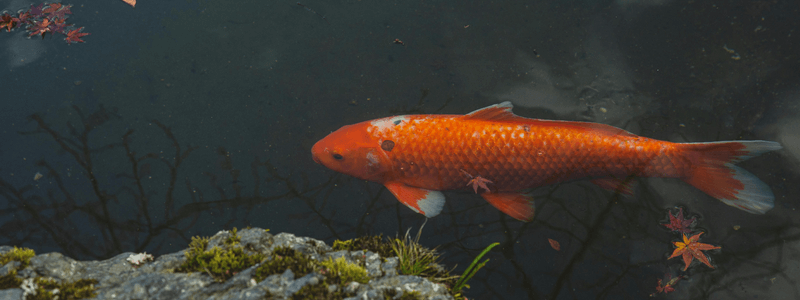
Koi are living art. Each fish carries centuries of selective breeding, careful pattern development, and cultural significance from Japan, where koi keeping has been refined into an extraordinary craft. With over 100 recognized varieties each has its own name, history, and specific characteristics. Koi offer almost endless visual diversity for pond owners.
Whether you’re planning an ornamental pond for your Portuguese garden, considering adding koi to an existing water feature, or simply trying to identify the beautiful fish you saw at a friend’s property, understanding koi types is the first step toward appreciating these remarkable creatures properly.
This guide covers every major koi variety, organized by the 13 official classification groups used in koi shows worldwide, with clear identification tips, historical context, and guidance on which varieties suit different pond environments.
Key Takeaways
- There are over 100 koi varieties, organized into 13 main classification groups based on color, pattern, and scale type.
- Gosanke (Kohaku, Sanke, and Showa) are the “Big Three” varieties and the foundation of koi breeding worldwide.
- Each variety has specific identifying features: head markings, scale patterns, metallic finish, and color placement all matter.
- Some varieties like Doitsu (scaleless) and Ginrin (sparkling scales) are modifiers that can apply across multiple base types.
- In Portugal’s climate, koi thrive in ornamental ponds year-round with proper depth, filtration, and shade.
- Koi appreciation is subjective. The “best” variety is the one you find most beautiful and suits your pond’s aesthetic.
Build a Pond Worthy of Your Koi
Understanding Koi Types
Before diving into individual varieties, it’s helpful to understand how koi are classified. Unlike dog breeds, where each type is distinct and separate, koi varieties overlap and combine in complex ways. A single koi might be a Doitsu (scaleless) Ginrin (sparkling) Sanke: that’s three classification layers on one fish.
The Japanese organize koi into 13 main groups for show judging. Within each group are numerous specific varieties. Some groups are based on color pattern (Gosanke), others on metallic finish (Hikarimono), and still others are catch-all categories for koi that don’t fit elsewhere (Kawarimono).
Understanding this structure helps make sense of the hundreds of variety names you’ll encounter. Let’s start with the most important group of all.
1. Gosanke: The Big Three
Gosanke means “the three families” in Japanese, and refers to the three most prestigious and historically significant koi varieties: Kohaku, Taisho Sanke, and Showa Sanshoku. These three varieties dominate koi competitions, set the standard for pattern quality, and are the foundation from which many other varieties were developed.
Kohaku
The most iconic koi variety. Kohaku are white-bodied koi with red (hi) markings. The pattern should be bold, clean-edged, and evenly distributed across the body without being overly busy. The head should have red markings, but the red should not extend past the eyes or cover the entire head.
Kohaku are considered the foundation of all koi breeding. Mastering Kohaku is seen as mastering koi itself. In competitions, judges evaluate Kohaku on pattern balance, color intensity, and body conformation more strictly than any other variety.
How to identify: White body, red patches only (no black). Clean pattern edges, vibrant red.
Taisho Sanke (Sanke)
Sanke are white koi with red and black markings. They developed from Kohaku by adding black (sumi) accents. The key distinguishing feature: Sanke have no black on the head. The black markings should be small, balanced, and appear primarily on the body above the lateral line.
High-quality Sanke resemble Kohaku with tasteful black highlights rather than fish overwhelmed by black. The sumi should complement the red pattern, not compete with it.
How to identify: White body, red and black markings, clean white head with no black.
Showa Sanshoku (Showa)
Showa also feature white, red, and black, but unlike Sanke, Showa have a black base color rather than white. Black wraps around the entire body, including below the lateral line and over the head. The red and white sit on top of this black foundation.
Showa are bold, dramatic fish with strong contrast. The black (sumi) should be deep and glossy, creating striking patterns that often resemble lightning bolts or calligraphy across the body.
How to identify: Black base color, red and white overlaid on top, black on the head, black extends below the lateral line.
Quick distinction between Sanke and Showa:
- Sanke: white base, no black on head, black only above lateral line
- Showa: black base, black on head, black wraps entire body
2. Utsurimono (Utsuri)
Utsuri means “reflection” in Japanese. These koi have a black body with bold patches of a second color – either white, red, or yellow. There are three main Utsuri varieties:
Shiro Utsuri
Black body with white markings. Often compared to Showa, but Shiro Utsuri have only two colors (black and white), whereas Showa have three.
Hi Utsuri
Black body with red (hi) markings. Less common than Shiro Utsuri but striking when well-bred.
Ki Utsuri
Black body with yellow markings. The rarest of the three Utsuri types.
How to identify Utsuri: Black base color, one accent color, always has black markings on the head.
3. Bekko
Bekko are the reverse of Utsuri: instead of black with color markings, they’re colored with black markings. The base color can be white, red, or yellow, and black sumi appears in a stepping-stone pattern across the body.
The key identifier: Bekko have clean heads with no black markings, unlike Utsuri which always have black on the head.
Shiro Bekko
White body with black markings.
Aka Bekko
Red or orange body with black markings.
Ki Bekko
Yellow body with black markings (rare).
How to identify Bekko: Solid colored base (white, red, or yellow), black stepping-stone pattern, no black on head.
4. Asagi and Shusui
These are among the oldest koi varieties, both featuring blue coloration.
Asagi
Fully scaled koi with a pale blue to grey-blue body covered in a distinctive net-like pattern (reticulation). The scales have dark blue edges creating this net effect. Red (hi) appears on the belly, gill plates, and fin bases. The head should be pale and clean.
Asagi are calm, elegant fish with understated beauty. When young, their heads can be translucent enough to see the skull beneath.
How to identify: Blue net-patterned back, red belly and fins, clean pale head.
Shusui
The scaleless (Doitsu) version of Asagi. Shusui have smooth, pale blue skin with a single row of large mirror scales along the dorsal line. Red markings appear on the sides, cheeks, and fins.
Shusui are often recommended for beginners because their smooth skin and bold scale line make them visually striking and easy to appreciate.
How to identify: Pale blue body, single row of dark blue scales along back, red on lower body, scaleless skin.
5. Koromo
Koromo means “robed” in Japanese. These koi were created by crossing Kohaku with Asagi in the 1950s, resulting in white-bodied koi with red markings that have a dark blue or black reticulated (netted) overlay on the scales.
The three main Koromo varieties are:
Ai Goromo
Red markings with blue-edged scales creating a purple appearance.
Sumi Goromo
Red markings with black-edged scales.
Budo Goromo
Red markings with a combination of red and blue creating a grape-like (budo means grape) effect.
How to identify: White body, red patches with dark overlay pattern on scales (inherited from Asagi parentage).
6. Goshiki
Goshiki means “five colors.” These koi were created by crossing Asagi with Sanke, combining the net pattern of Asagi with the red, white, and black of Sanke. The result is a complex, multi-colored fish displaying white, red, black, light blue, and dark blue.
Goshiki are visually busy fish with intricate patterns that reward close observation. The Asagi influence gives them the characteristic net pattern across their scales.
How to identify: Multiple colors (white, red, black, blue) combined, netted scale pattern from Asagi heritage, complex overall appearance.
7. Kawarimono
Kawarimono is a catch-all classification for non-metallic koi that don’t fit into other categories. This group contains some of the most unique and striking varieties.
Chagoi
Solid brown or bronze koi, often greenish-brown. Chagoi are beloved not for flashy colors but for their friendly, docile personalities. They’re often the first koi to approach people at feeding time and tend to calm more skittish fish in the pond.
Ochiba Shigure
“Autumn leaves on water” have grey-blue base (from Asagi heritage) with brown or orange markings resembling fallen leaves. Ochiba are increasingly popular for their earthy, natural coloration.
Kumonryu
Black and white koi with dramatic, ever-changing patterns. Kumonryu markings shift over time with water temperature and season, making each fish genuinely unique.
Benigoi
Solid red or orange koi with no other markings.
Kigoi
Solid yellow koi.
How to identify Kawarimono: Wide variety where you can look for solid colors, unusual patterns, or combinations that don’t fit standard classifications.
8. Hikarimuji (Ogon)
Hikarimuji refers to single-colored metallic koi. Ogon means “golden” and is the most common term for these fish.
Yamabuki Ogon
Metallic yellow or gold.
Platinum Ogon (Purachina)
Solid metallic white or silver.
Orenji Ogon
Metallic orange.
Ogon are bold, eye-catching fish that stand out in any pond due to their brilliant metallic shine. They’re popular with beginners because their solid color makes them easy to appreciate and they tend to be hardy.
How to identify: Single solid color, metallic sheen, no pattern or markings.
9. Hikarimoyo
Metallic koi with two or more colors. This group includes some of the most ornate varieties.
Hariwake
Two-toned metallic koi, typically platinum (white) with orange or gold markings.
Kujaku
Metallic koi with a net pattern similar to Asagi but with a shimmering finish. “Kujaku” means peacock.
Yamatonishiki
Metallic Sanke with white base with a bit of red and black, all with metallic sheen.
How to identify: Metallic finish, multiple colors or patterns (not solid).
10. Hikari Utsuri
Metallic versions of the Utsuri and Showa varieties.
Kin Showa
Metallic Showa with gold sheen.
Gin Showa
Metallic Showa with silver sheen.
Kin Ki Utsuri
Metallic Ki Utsuri (black and yellow with metallic finish).
How to identify: Black base with metallic overlay, follows Utsuri/Showa pattern rules.
11. Tancho
Tancho is a special classification based on a single feature: a round red marking on the head with an otherwise white body. Tancho koi resemble the Japanese flag and are highly prized in Japan for this symbolic connection.
Tancho can technically be Kohaku, Sanke, or Showa, as long as the only red marking is the single circular patch on the head.
How to identify: White body, single round red spot on head, no other red markings anywhere.
12. Doitsu
Doitsu refers to scaleless or partially scaled koi. “Doitsu” means “German”. These koi were developed by crossing Japanese koi with German mirror carp in the early 1900s.
Doitsu koi either have no scales at all, or retain only a single row of large mirror scales along the back (dorsal line) and/or lateral line. Doitsu is a modifier that can apply to almost any variety: Doitsu Kohaku, Doitsu Sanke, Doitsu Showa, etc.
The smooth, scaleless skin makes colors appear more intense and gives these fish a sleek, modern appearance.
How to identify: No scales or only mirror scales along back/sides, smooth skin, colors appear more vivid.
13. Ginrin and Kinrin
Ginrin (silver sparkling) and Kinrin (gold sparkling) refer to koi with diamond-like, reflective scales that shimmer intensely under sunlight. Like Doitsu, Ginrin is a modifier that can apply to any variety.
True Ginrin scales are individually reflective. Each scale catches light separately, creating a sparkling effect across the body. This is different from metallic koi (Hikari varieties) which have an overall metallic sheen.
How to identify: Individual scales sparkle like diamonds in sunlight, base pattern follows another variety (e.g., Ginrin Kohaku).
How to Identify Koi: A Quick Reference
When trying to determine a koi’s variety, ask these questions in order:
- Is it metallic? If yes, it’s in the Hikari group (Hikarimuji, Hikarimoyo, or Hikari Utsuri).
- How many colors does it have?
- One solid color → Kawarimono or Hikarimuji (if metallic)
- Two colors → Likely Utsuri, Bekko, Asagi/Shusui, or Hariwake
- Three colors → Gosanke (Sanke or Showa), Koromo, or Goshiki
- What’s the base color?
- White base → Kohaku, Sanke, Bekko, Koromo
- Black base → Showa, Utsuri
- Blue/grey base → Asagi, Shusui, Ochiba
- Are there black markings on the head?
- Yes → Showa or Utsuri
- No → Sanke, Bekko, or Kohaku
- Does it have scales?
- No scales or mirror scales only → Doitsu variant
- Sparkling individual scales → Ginrin variant
Choosing Koi for Your Pond
Portugal’s climate is excellent for koi keeping. The warm summers support active feeding and growth, and the mild winters rarely threaten outdoor ponds if designed with adequate depth (minimum 1.2 meters recommended for thermal stability).
When selecting koi varieties for an ornamental pond in Portugal:
Consider shade and sun exposure: Koi need both sun (for color development) and shade (for comfort during hot summer days). Varieties like Asagi and Shusui show their blue coloration particularly well in dappled light. Metallic varieties (Ogon, Hariwake) shine brilliantly in direct sun.
Plan for growth: Koi can reach 60 to 90 cm in proper conditions and live for decades. Choose varieties that suit the visual scale of your pond. Bold patterns like Showa work well in larger ponds, while subtle varieties like Ochiba or Chagoi suit more intimate spaces.
Think about water clarity: Natural pools with biological filtration provide the clear water koi need to display their patterns properly. In conventional filtered ponds, regular maintenance is essential as cloudy water diminishes the beauty of even the finest koi.
Mix patterns thoughtfully: A pond with only busy, multi-colored koi (Goshiki, Koromo) can look chaotic. Balance complex patterns with simpler varieties: a few solid Ogon or Chagoi among patterned fish creates visual breathing room.
Koi in Natural Pond Ecosystems
Ornamental ponds designed with natural filtration, the kind Oásis Biosistema creates throughout Portugal, offer an ideal environment for koi. The planted regeneration zones process waste naturally, maintain stable water parameters, and create the crystal-clear conditions where koi patterns and colors are displayed at their best.
Natural ponds also support the microorganisms and aquatic life that koi instinctively forage for, encouraging natural behaviors and reducing dependence on artificial feeding. The result is healthier, more vibrant koi in a pond that requires far less chemical intervention and mechanical maintenance than conventional systems.
If you’re planning an ornamental pond for koi, or considering adding koi to an existing water feature, the design and ecosystem matter as much as the fish selection. A well-designed pond makes koi keeping genuinely enjoyable rather than a recurring maintenance burden.
Oásis Biosistema designs and builds ornamental ponds and natural pools across Portugal, with careful attention to koi compatibility, water quality, and long-term ecosystem balance. Get in touch to discuss what’s possible for your space.
Conclusion
With over 100 varieties organized into 13 main groups, koi offer extraordinary diversity. From the iconic elegance of Kohaku to the bold drama of Showa, the understated beauty of Asagi to the brilliance of metallic Ogon, there’s a koi variety to suit every aesthetic preference and pond environment.
Understanding the classification system with base color, pattern placement, metallic finish, or scale type, makes identifying koi straightforward even for beginners. And ultimately, the “best” koi variety is the one that speaks to you when you see it gliding through clear water in your garden.
FAQ
How many types of koi are there?
There are over 100 recognized varieties of koi fish, grouped into around 15–20 main categories. These varieties are classified based on color, pattern, and scale type, with popular groups including Kohaku, Sanke, Showa, and Butterfly koi.
What is the best type of koi fish?
The “best” koi depends on preference, but Kohaku is often considered the most classic and desirable. It features a white body with red markings and is highly valued for its simplicity, balance, and traditional beauty in koi competitions.
What is the friendliest koi breed?
All koi are generally friendly and can become very tame, especially when hand-fed. Butterfly koi and standard koi varieties alike are known for recognising their owners and interacting at feeding time, making them popular as interactive pond fish.
What color koi is most valuable?
High-quality red and white (Kohaku) koi are often the most valuable, especially with clean patterns and strong color contrast. Rare varieties like Showa or metallic koi can also be highly valuable, depending on pattern quality, lineage, and overall appearance.