
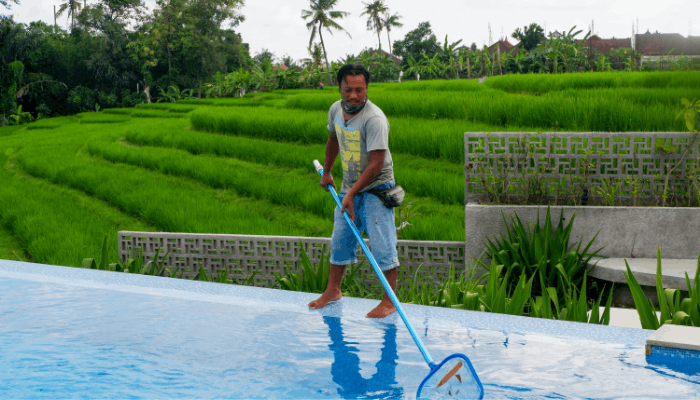
No vacuum? No problem. Whether yours has broken down, you simply don’t own one, or you’re exploring smarter ways to maintain your pool, there are several effective methods to keep the water crystal clear and the bottom spotless, and no suction hose required.
This guide covers everything from quick manual fixes to longer-term solutions, including why natural pools are one of the lowest-maintenance options you can choose.
Key Takeaways
- A pool vacuum is useful, but it’s far from the only way to keep your pool clean.
- Brushing, skimming, manual siphoning, and optimising your filtration system can handle most debris effectively.
- Flocculants and clarifiers are powerful chemical allies when fine particles cloud your water.
- Robotic cleaners and pressure-side tools offer hands-free alternatives without manual vacuuming.
- Natural pools have a built-in advantage: their aquatic ecosystems reduce debris buildup significantly, often eliminating the need for vacuum cleaning altogether.
- Prevention with pool covers, smart landscaping, and good water chemistry is always easier than cure.
What If the Answer Was Just – Don't Vacuum?
Why Pool Cleaning Matters Beyond Aesthetics
A dirty pool isn’t just an eyesore. Debris that settles on the pool floor creates the perfect environment for algae to take hold, throws off your water chemistry, and puts extra strain on your filtration system. In Portugal’s warm climate, where pools are used for much of the year and dust, pollen, and pine needles are constant visitors, staying on top of pool cleanliness is particularly important.
The good news is that vacuum cleaning, while effective, is just one tool in a larger toolkit.
1. Brush the Pool Floor and Walls
This is your first line of defence and the foundation of any vacuum-free cleaning routine. A good pool brush attached to a telescopic pole can dislodge dirt, algae spores, and fine sediment from every surface, sending it into suspension where your filtration system can catch it.
How to do it properly: Use a nylon brush for fibreglass or vinyl pools and a stainless steel brush for concrete. Work in slow, sweeping strokes from the shallow end toward the deep end, and pay special attention to steps, corners, and the area around ladders, these spots collect the most debris and are where algae tends to start.
Brush at least once a week as part of your regular routine. After brushing, run your pump for a few hours to let the filter capture what you’ve loosened.
2. Skim with a Leaf Rake or Fine-Mesh Net
Surface skimming prevents debris from sinking in the first place. A standard skimmer net is fine for leaves and larger items, but for fine particles like pollen, sand, or dust, which are common in Portugal, a fine-mesh skimmer bag makes a noticeable difference.
Skim the surface daily if possible, particularly after windy days or heavy pollen seasons. The less debris that reaches the floor, the less you’ll need to deal with down the line.
For the pool floor itself, a deep-bag leaf rake on a telescopic pole works well for collecting settled leaves and debris without stirring up fine sediment.
3. Manual Siphoning with a Garden Hose
This low-tech method is surprisingly effective for targeting small, localised areas of sediment or fine dirt. It works on the same principle as a vacuum, creating suction, but uses water pressure rather than a dedicated machine.
Step-by-step:
- Submerge your garden hose completely until it’s fully filled with water and all air bubbles are gone.
- Cap one end tightly with your thumb.
- Lower the uncapped end to the pool floor, positioning it directly over the debris you want to remove.
- Release your thumb, the siphon effect will begin drawing water (and debris) out of the pool.
- Direct the outflow away from your pool to avoid the dirty water cycling back in.
This works best for small patches of sediment. For larger areas, you’ll need to combine it with brushing and filtration.
4. Use a Pool Clarifier or Flocculant
When your pool water looks cloudy or fine particles are suspended throughout, chemicals can do heavy lifting that no physical tool can match.
Clarifier works by binding tiny particles together into larger clumps that your filter can catch. It’s safe for regular use and won’t affect your water chemistry significantly.
Flocculant (also called floc) is a stronger option. It causes particles to clump and sink to the pool floor, where they form a visible layer. The catch is that you then need to remove that layer, traditionally by vacuuming to waste. However, if you combine floc with careful siphoning or a fine-mesh net, you can manage it without a vacuum. Use flocculant sparingly and follow the manufacturer’s dosage instructions carefully.
Always test and balance your water chemistry before using either product – pH between 7.2 and 7.6, and chlorine levels where they should be, make these treatments far more effective.
5. Optimise Your Filtration System
Your filter and pump are doing the silent, continuous work of keeping your water clean, but only if they’re running correctly. A poorly maintained filter won’t capture fine debris no matter how much you brush or skim.
To maximise filtration without a vacuum:
- Run your pump for 8–12 hours per day during summer (Portugal’s heat accelerates algae growth).
- Clean or backwash your filter regularly and sand filters need backwashing every 1 to 2 weeks during heavy use.
- Consider running the pump slightly longer after storms, high-use days, or dusty periods.
- Add a pool clarifier after brushing to help the filter catch the fine particles you’ve dislodged.
A well-functioning filter combined with regular brushing eliminates the need for vacuum cleaning in many situations.
6. Use a Robotic Pool Cleaner or Pressure-Side Cleaner
If you want automation without the hassle of a traditional vacuum setup, robotic cleaners are worth considering. These devices operate independently of your filtration system, navigate the pool floor on their own, and collect debris in a built-in basket.
Unlike suction-side vacuums (which connect to your skimmer and can stress your pump), robotic cleaners run on their own motor and don’t add any load to your filtration system. They’re particularly useful for larger pools where manual brushing and skimming becomes time-consuming.
Pressure-side cleaners are another option, they use the return jets from your pump to propel themselves around the pool and collect debris in a bag. They work best in pools that already have good water circulation.
7. Improve Circulation with Return Jet Direction
This is an often-overlooked trick. Your pool’s return jets (the fittings through which filtered water re-enters the pool) can be angled to create a circular current that drives floating debris toward your skimmer basket rather than letting it settle.
Point your return jets slightly downward and in the same rotational direction, clockwise or anticlockwise, depending on your skimmer placement. This creates a slow, steady vortex that continuously channels lightweight debris toward the skimmer for collection.
It won’t solve a heavily dirty pool on its own, but as a passive, ongoing maintenance strategy, it reduces how often you need to clean at all.
The Easiest Option: A Natural Pool
If you find pool maintenance a recurring burden, it’s worth stepping back and asking whether your pool is working against you.
Natural pools, the kind designed and built by Oásis Biosistema, function through biological filtration. Aquatic plants and beneficial microorganisms do the work that chemicals and machines do in conventional pools, maintaining water clarity without the constant intervention those systems demand.
Because natural pools have a living ecosystem doing the filtering, fine particles and organic debris are processed naturally. There’s no need for weekly vacuuming, backwashing, or chemical shocking. The maintenance routine is genuinely simpler, and the result is water that feels different: soft, clean, and alive in a way that chlorinated water simply isn’t.
In Portugal’s climate, natural pools are particularly well-suited to the landscape and lifestyle. They integrate beautifully into garden design, support local biodiversity, and look as though they belong there, because they do.
Prevention: The Best Cleaning Strategy of All
Every method above is easier if you reduce how much debris enters your pool in the first place.
A few habits that make a real difference:
- Use a pool cover when the pool isn’t in use, especially overnight and during dusty or windy periods. Portugal’s summer winds carry a surprising amount of dust and pollen.
- Shower before swimming as sunscreen, body oils, and cosmetics all contribute to cloudy water and put extra load on your filter.
- Trim nearby trees and shrubs strategically. A thoughtful landscaping plan from the outset can dramatically reduce the amount of leaves and debris that reach the water.
- Maintain water chemistry consistently since balanced water is resistant to algae and keeps fine debris in suspension where the filter can catch it, rather than letting it settle.
Conclusion
Cleaning a pool without a vacuum is entirely achievable, and in many cases, the methods above are less time-consuming than vacuum cleaning when done consistently. Brush regularly, skim daily, optimise your filtration, and use chemistry intelligently, your pool will stay clean without the machine.
And if you’re at the stage of building a new pool or reconsidering your current setup entirely, a natural pool removes most of this effort from the equation. The ecosystem does the work. You just swim.
Oásis Biosistema designs and builds natural pools, ornamental ponds, and luxury landscaping in Portugal. If you’d like to explore a pool that practically maintains itself, get in touch with our team.
FAQ
What can you use instead of a pool vacuum?
Instead of a pool vacuum, you can use a pool brush, leaf net, or skimmer to remove debris. Brushing dirt toward the main drain and running the filter continuously helps clear fine particles. For light debris, a manual net and brushing can be effective.
Can you clean a pool without a vacuum?
Yes, you can clean a pool without a vacuum by brushing walls and floors, skimming debris, and maintaining proper water chemistry. Running the filter longer and shocking the pool when needed helps remove dirt and algae, though vacuuming is faster for heavy debris.
How do I vacuum my pool manually?
To vacuum a pool manually, attach the vacuum head to a telescopic pole and hose, fill the hose with water to remove air, then connect it to the skimmer. Move slowly across the pool floor to avoid stirring debris while the pump is running.
How to clean a dirty pool fast at home?
To clean a dirty pool quickly, skim debris, brush all surfaces, shock the pool, and run the filter continuously. Clean or backwash the filter daily during the process. For faster results, vacuum debris to waste if possible to prevent re-circulation.