Pool filters themselves don’t use electricity but the pumps that run them do. And depending on how long you run your system each day, and what kind of pump you have, your pool could be using more energy than you think.
For many homeowners, the pool pump is one of the most energy-hungry devices on the property, especially during summer. In this post, we’ll break down how electricity use works in pool filtration systems, how much energy different pumps consume, and what practical steps you can take to lower your energy bill without sacrificing water quality.
Key Takeaways
- Pool filters themselves don’t use electricity but pumps do.
- The type of pump and how long it runs impacts your energy bill the most.
- Single-speed pumps are the least efficient and use the most power.
- Variable-speed pumps can reduce energy use by up to 75%.
- Dirty or clogged filters make your pump work harder and use more electricity.
- Most pools only need 6 to 8 hours of filtration per day in warmer months.
- Adding a timer, cleaning your filter, and upgrading your pump can significantly cut energy costs.
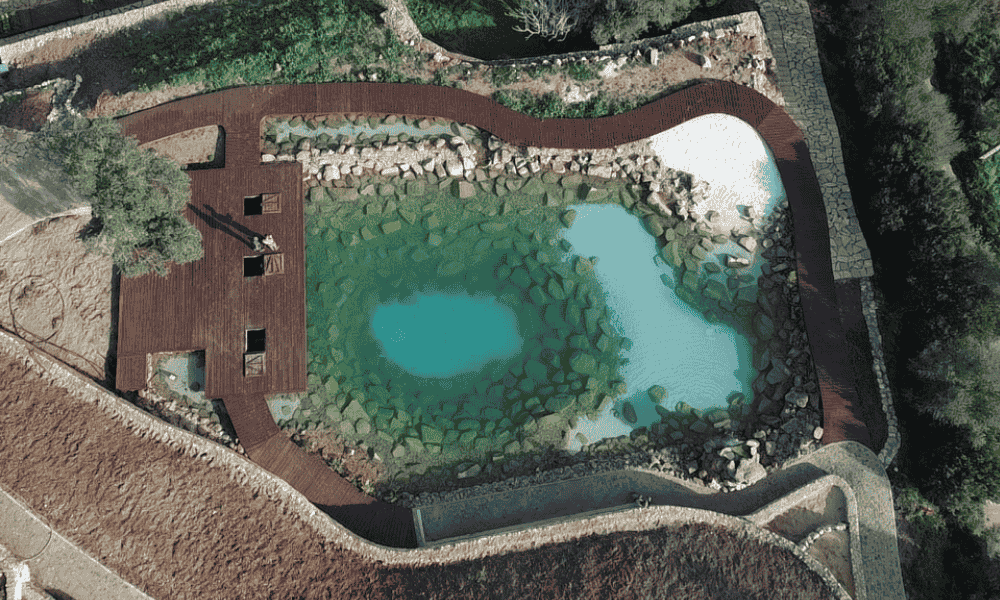
- Natural pool systems, when designed efficiently, can further reduce power use and environmental impact.
What Part of Your Pool Actually Uses Electricity?
It’s easy to assume that the pool filter itself is consuming electricity, but that’s not quite how it works. The filter is a passive component. It doesn’t plug into anything or generate its own power use. The pool pump, however, is what moves the water through the filter, and that’s where the energy bill comes in.
If you’re trying to understand what’s using power in your pool setup, you need to focus on the pump. The pump draws water from the pool, pushes it through the filter, and then returns the clean water back into circulation. That entire process can run for hours each day, depending on how your system is set up.
There are different types of pumps like single-speed, dual-speed, and variable-speed, and they vary significantly in how much electricity they consume. We’ll get into that in a moment.
How Much Electricity Does a Pool Pump Use?
The short answer is: it depends on the pump and how long it runs each day. But let’s break it down.
A standard single-speed pump typically uses between 1 and 2 kilowatt-hours (kWh) per hour of operation. If you run it for 8 hours a day, you’re looking at 240 to 480 kWh per month. At the national average electricity rate of $0.15 per kWh, that could add $36 to $72 per month, just for the pump.
On the other hand, a variable-speed pump uses significantly less power, often between 0.2 and 0.5 kWh per hour. That’s a big difference, especially over the course of a full swimming season. In fact, according to the U.S. Department of Energy, switching to a variable-speed pump can reduce energy use by 50 to 75 percent.
It adds up quickly.
Does Filter Type Affect Electricity Use?
Not directly. The filter, whether it’s a sand filter, cartridge filter, or diatomaceous earth (DE) filter, doesn’t use electricity on its own. But it does affect how hard your pump has to work.
If a filter is clogged or hasn’t been cleaned regularly, it adds resistance to the system. That forces the pump to push harder to move water through the filter, which increases electricity consumption. So while the filter itself isn’t using power, its condition absolutely influences your overall energy use.
Keeping your filter clean is a simple but effective way to keep energy costs in check.
What’s It Actually Costing You?
Let’s put it in perspective. If your pool pump runs for 8 hours a day on a single-speed setup, you could be spending over $700 a year on electricity just to keep the water circulating.
That’s more than a refrigerator. More than a dishwasher. Possibly even more than your HVAC system during the shoulder seasons.
You might not notice the cost in a single bill, but over time, it’s significant. Especially if you’re running the pump longer than necessary or using a system that isn’t optimized for efficiency.
How Long Should You Run Your Pool Filter Each Day?
Most pool owners don’t need to run the pump all day. In general, 6 to 8 hours per day during summer is enough to keep the water clean and properly circulated. In cooler months, you can get away with 4 to 6 hours.
If your pump is on 24/7, you’re likely wasting energy. Not only that, but constant operation can shorten the lifespan of your equipment.
A simple timer or smart controller can help automate run times and reduce unnecessary usage. Pair that with a properly maintained filter and you’ve already made a dent in your electricity use.
How to Reduce Pool Filter Energy Use Without Compromising Cleanliness
If you want to lower your pool’s electricity costs, there are a few steps that make a big difference:
- Upgrade to a variable-speed pump
These are far more efficient than older single-speed models and are often eligible for local rebates. You can run them at lower speeds for longer periods, which improves filtration and reduces cost. - Install a timer or smart controller
Automating your pump schedule ensures you’re only using electricity when it’s needed. Off-peak hours can be even cheaper if your utility offers time-of-use billing. - Keep your filter clean
Backwash sand and DE filters as recommended, and rinse or replace cartridge filters when they start to clog. - Size your pump correctly
Bigger isn’t always better. An oversized pump just uses more energy than necessary. Make sure your system is matched to your pool’s volume and plumbing. - Run the pump during non-peak hours
If your energy provider charges more during the day, consider running your pool pump early in the morning or overnight when rates are lower.
These changes are relatively easy to implement and can significantly reduce your monthly energy bill.
Common Myths About Pool Filter Electricity Use
There’s a lot of misinformation floating around (no pun intended), so let’s clear up a few things:
- Myth: The filter uses electricity.
False. The pump does the work. The filter is passive. - Myth: Bigger pumps clean better.
Not necessarily. Oversized pumps often create excess flow that your filter can’t handle efficiently. - Myth: You need to run your pump all day.
Unless your pool has heavy usage or special conditions, 6 to 8 hours is usually plenty. - Myth: The type of filter determines energy use.
Not directly. However, a clogged filter of any type will increase power draw because it forces the pump to work harder.
Understanding these common misconceptions can help you avoid unnecessary upgrades or energy waste.
When High Electricity Use Is a Red Flag
If your power bill has been creeping up and you haven’t changed much in your home, your pool pump could be the culprit. It’s worth checking if:
- The pump runs all day without a timer
- You’re using a single-speed pump that’s more than a few years old
- You notice poor water circulation even when the pump is running
- Your filter hasn’t been cleaned in a while
In some cases, you might also hear unusual sounds from the pump or notice it’s running hotter than usual. That could mean it’s working too hard and drawing more power than necessary.
You might also want to check for utility rebate programs in your area. Many cities and states offer financial incentives to homeowners who replace outdated pool equipment with energy-efficient models.
A Smarter Way to Run Your Pool
The pool filter may not be directly responsible for your electricity use, but it’s a key part of the system that drives it. If your pump is running too long, too fast, or through a dirty filter, you’re almost certainly using more energy than you need to.
A few smart adjustments, whether it’s a pump upgrade, a timer installation, or simply cleaning your filter more often, can lead to real savings over time.
And when your pool runs more efficiently, it’s not just your wallet that benefits. Your equipment lasts longer, your water stays cleaner, and you spend less time managing it all.
If you’re ready to optimize your system or aren’t sure where to start, we can help.
Conclusion
While your pool filter isn’t using electricity directly, the pump powering your filtration system absolutely is and in many cases, it’s consuming far more energy than necessary. The good news? It’s also one of the easiest parts of your pool setup to optimize.
By switching to a more efficient pump, cleaning your filter regularly, and adjusting your daily run times, you can significantly reduce your pool’s energy use without sacrificing water quality or performance. These aren’t big, complicated changes, they’re practical, high-impact improvements that save money and extend the life of your equipment.
At Oásis Biosistema, we specialize in building natural, energy-efficient pools that work with nature, not against it. Whether you’re starting from scratch or looking to upgrade your existing system, we can help you design a beautiful, low-impact pool that fits your space and reduces your long-term energy footprint.
Visit our website to learn more or get in touch for a consultation. Your pool can be crystal clear, eco-friendly, and cost-effective and we’d love to show you how.
FAQ
Should you leave a pool filter on all the time?
You don’t need to run a pool filter 24/7, but you should run it long enough to circulate all the water at least once or twice a day. Most pools require 8–12 hours of daily filtration, depending on size, debris load, and pump strength.
How much does it cost to run a pool filter daily?
Daily cost depends on pump size, electricity rates, and run time. On average, running a standard pool filter costs €1–€3 per day in Europe or $1–$4 per day in the U.S. Energy-efficient variable-speed pumps can cut this cost by 50–70%.
What runs up your electric bill the most?
Major contributors to high electric bills include heating and cooling systems, electric water heaters, pool pumps, dryers, and older appliances. Among pool equipment, the pool pump is typically the biggest energy user, especially if it runs long hours or uses a single-speed motor.
How much does it cost to run a pool pump per hour?
A typical pool pump costs €0.10 to €0.40 per hour (or $0.10–$0.50 in the U.S.), depending on wattage and electricity rates. Variable-speed pumps usually run closer to €0.05 to €0.15 per hour, making them significantly cheaper over the long term.