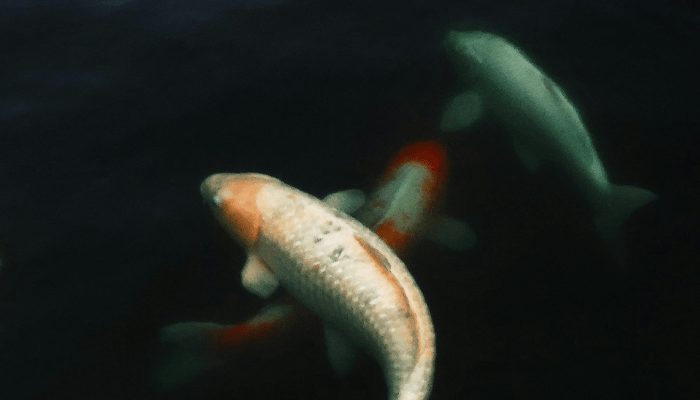
The eye color of koi varies from standard dark brown-black (wild-type with high melanin concentration in the iris) to orange, orange-red variations and rare blue-grey variations determined by melanin levels in iris tissue controlled by specific genes, including the dominant R allele that causes red eyes through partial reduction of melanin (RR and Rr genotypes produce red eyes, while rr produces black eyes). Eye color corresponds to body color genetics – metallic Ogon varieties often display orange-tinted eyes that complement golden body coloration, blue-grey Asagi and Shusui koi can show blue-grey iris that matches dorsal scale coloration, while most patterned varieties (Kohaku, Sanke, Showa) retain standard dark eyes that provide contrast with white, red and black body patterns.
This guide addresses eye color genetics (eumelanin and phaeomelanin melanin types, dominant R gene mutation), characteristics of standard dark eyes, orange-red eye variations in metallic and yellow varieties, blue-grey eyes in Asagi/Shusui lineages, the distinction of albinism (complete absence of melanin causing truly red eyes from visible blood vessels compared to partial reduction in typical red-eyed koi), changes in eye color with age and environment, visible health indicators through eye observation and water clarity requirements of natural pools for observing koi eyes.
Key Takeaways
- Standard eye color: dark brown-black – high melanin concentration (eumelanin) in iris
- Red eyes: dominant R gene – partial melanin reduction, not true albinism
- Orange eyes: metallic varieties – common in Ogon, correlate with body color genetics
- Blue-grey eyes: rare – Asagi/Shusui lineages, correspond to dorsal scale coloration
- Eye color corresponds to body genetics – melanin genes affect both skin and eyes
- Clarity indicator: bright and clear eyes – cloudiness and opacity signal health problems
- Pupil is always black – regardless of iris color, pupil remains dark
- Visibility in natural pools – 1–3 meters clarity allows observation of koi eye details
- Eye color changes with age and environmental conditions
Eye Anatomy and Melanin
Iris Structure
Iris: Colored ring surrounding the pupil. Contains melanocytes (pigment cells) that produce melanin determining eye color.
Pupil: Central black opening that allows light to reach the retina. The pupil remains black in all koi regardless of iris color.
Sclera: White outer layer of the eyeball (not visible in koi – covered by transparent cornea and skin).
Types of Melanin
Eumelanin: Brown-black pigment. High concentration of eumelanin creates dark brown or black iris color. Dominant in wild-type koi and most ornamental varieties.
Phaeomelanin: Orange-yellow pigment. Lower concentration than eumelanin in most koi. More visible in varieties with reduced eumelanin, allowing phaeomelanin to manifest as orange or yellow tint in eyes.
Color determination: Eye color results from varying concentrations and distributions of eumelanin and phaeomelanin in iris melanocytes. High eumelanin produces dark eyes; reduced eumelanin with maintained phaeomelanin produces orange-red eyes; minimal melanin produces blue-grey or light eyes.
Standard Dark Eyes (Wild-Type)
Characteristics
Color: Dark brown to black iris. Appears nearly black under most lighting conditions.
Melanin content: High concentration of eumelanin throughout iris tissue.
Genetics: Recessive genotype rr (homozygous recessive at R locus) produces standard dark eyes. Most koi carry the rr genotype.
Prevalence: Most common eye color in all koi varieties. Standard in Kohaku, Sanke, Showa, Bekko, Utsuri, Koromo, Chagoi, Kumonryu and most other varieties.
Visual Effect
Contrast enhancement: Dark eyes provide strong contrast with white, red or light-colored body areas. Enhances visual appeal of patterned varieties where the eye stands out sharply.
Depth perception: Dark iris makes pupils less visible, creating a unified dark eye appearance. Gives impression of depth and alertness.
Exhibition preference: Most koi exhibition standards prefer dark eyes as classic and traditional appearance. Red or orange eyes are acceptable in specific varieties (metallic Ogon), but considered a fault in most patterned varieties.
Red and Orange Eyes
Genetics
Dominant R gene mutation: Red eye phenotype is controlled by dominant R allele. Koi with RR (homozygous dominant) or Rr (heterozygous) genotypes display orange-red eyes. Only rr (homozygous recessive) produces standard dark eyes.
Inheritance pattern: Red-eyed koi crossed together produce offspring segregating in approximately 3:1 ratio (three red-eyed to one dark-eyed) following Mendelian genetics. Dark-eyed koi crossed together produce only dark-eyed offspring (rr × rr = rr).
Partial melanin reduction: R allele reduces but does not eliminate melanin production in iris. Eumelanin is diminished allowing phaeomelanin (orange-yellow pigment) to dominate iris color. This differs from true albinism which completely eliminates melanin.
Interaction with body color: R gene affects eyes independently, but melanin-related genes affecting body color may influence eye color expression. Koi with intense black body pigmentation tend to show darker eyes even when carrying the R allele.
Appearance
Color range: Orange, orange-red, amber or reddish-brown depending on individual melanin levels and genetic background.
Not truly red: Unlike albino organisms where eyes appear bright red from visible blood vessels, red-eyed koi retain some melanin giving orange-red or amber appearance rather than pure red.
Iris opacity: Iris remains opaque (not transparent) due to residual melanin and structural proteins. Pupil is still clearly defined as the dark center.
Common Varieties with Orange-Red Eyes
Ogon (metallic gold/platinum): Orange-tinted eyes common in metallic varieties, particularly Yamabuki Ogon (gold) and Orenji Ogon (orange). Eye color complements golden or orange body coloration.
Akame Kigoi: Literally translates as “red-eyed yellow fish”. Yellow-bodied koi specifically bred for orange-red eye characteristics. Uncommon special variety.
Certain Shusui: Some Shusui lineages (blue scaleless koi) display orange or reddish iris tint, though dark eyes are more typical.
Metallic varieties generally: Platinum Ogon and other single-color metallic koi may show orange iris tint more frequently than patterned varieties.
Blue-Grey Eyes
Characteristics
Color: Pale blue-grey, silver-grey or steel-blue iris.
Rarity: Uncommon. Observed most frequently in Asagi and Shusui varieties (blue-bodied koi).
Melanin content: Low total melanin. Reduced eumelanin allows light to scatter in iris tissue creating a blue appearance (mechanism similar to blue eyes in humans, where absence of brown pigment allows short-wavelength light to scatter).
Genetics: Not fully understood. It appears linked to genes controlling blue body pigmentation in Asagi/Shusui, but specific genetic mechanisms require further investigation.
Visual Effect
Body coordination: Blue-grey eyes complement blue dorsal scales in Asagi and Shusui creating a cohesive color scheme from eyes to tail.
Distinctive appearance: Blue eyes make these varieties particularly striking and recognizable.
Exhibition consideration: In Asagi and Shusui, blue eyes are generally acceptable. In other varieties, blue eyes may be considered unusual or undesirable depending on judge preference.
Albinism vs Red Eyes
True Albinism
Definition: Complete absence of melanin in both skin and eyes caused by recessive albino mutations.
Eye appearance: Eyes appear bright red or pink because blood vessels in the retina and choroid (vascular layer) become visible through melanin-free transparent iris.
Body appearance: Albino koi would have white or pale yellow body without dark pigmentation, bright red eyes and transparent fins.
Rarity in koi: True albinism is extremely rare in koi. Most “red-eyed” koi are not albino but carry R gene causing partial melanin reduction.
Red Eyes from R Gene (Pseudo-Albinism)
Melanin present: Iris contains reduced but not eliminated melanin. Eyes appear orange-red or amber, not bright red.
Body pigmentation: Koi with R gene can have normal body coloration including black, red and white patterns. Melanin reduction in eyes does not necessarily imply body depigmentation.
Distinction: R gene specifically affects melanin in eyes (and slightly in skin) but allows normal pattern color development, unlike true albinism which eliminates all melanin.
Changes in Eye Color
Age-Related Changes
Juvenile to adult: Young koi may display lighter eye color (greater orange or amber tint) that darkens as fish matures and melanin concentration increases with age.
Elderly koi: Very old koi (15+ years) may develop cloudiness or lens opacity (cataract formation) affecting eye appearance. Iris color typically remains stable but lens clarity decreases.
Environmental Factors
Water quality: Poor water quality (high ammonia, nitrite, low oxygen) can cause eye cloudiness or opacity regardless of genetic eye color. Healthy water maintains clear bright eyes.
UV exposure: Outdoor pools with direct sunlight exposure may intensify eye pigmentation over time compared to shaded or indoor environments.
Temperature: No direct effect on iris color, but temperature stress can cause temporary cloudiness or redness in eye tissues.
Disease-Related Changes
Cloudiness: Bacterial or parasitic infections can cause corneal opacity making eyes appear cloudy or milky regardless of iris color.
Redness: Inflammation from injury, infection or poor water quality causes dilation of blood vessels in eye tissues creating red appearance around iris (not in iris itself).
Exophthalmia (protruding eye): Swelling behind the eyeball pushes the eye outward. Can result from bacterial infection, poor water quality or internal parasites. The affected eye appears protruding and possibly cloudy.
Eye Health Indicators
Healthy Eye Characteristics
Clarity: Transparent cornea, bright and distinct iris color and clearly defined black pupil center.
Position: Eyes sit level with head, neither sunken nor protruding.
Symmetry: Both eyes match in size, color and position. Asymmetry suggests injury or disease.
Response: Pupil dilates and constricts in response to light changes. Eyes track movement indicating functional vision.
Signs of Problems
Cloudiness: White, grey or milky appearance over eye surface. Indicates infection, injury or water quality problem.
Swelling: Protruding and bulging eye. Signals bacterial infection, internal parasites or organ failure.
Sunken eyes: Eyes appear recessed in the head. Sign of dehydration, serious illness or starvation.
White film: Cottony or diffuse white growth on eye. Fungal or bacterial infection requiring treatment.
Bleeding: Red streaks or blood around the eye. Injury, bacterial infection or serious water quality problem.
Unequal pupils: One pupil larger than the other. Neurological damage, brain injury or infection.
Observing Koi Eye Color in Natural Pools
Natural pools maintain water clarity through biological filtration allowing detailed observation of koi including eye color and health assessment.
Water clarity requirements: Typical visibility 1–3 meters in well-maintained natural pools. Sufficient to observe koi eye details, pupil response and health indicators when fish swim near surface or mid-depth.
Natural coloration: Slight tea coloration from plant tannins does not impair koi observation. Tannins may enhance certain eye colors making orange and red eyes more vibrant against amber-tinted water.
Lighting conditions: Natural sunlight penetrating clear water shows koi eye colors accurately. Dimmed light in shaded areas may make eye color distinction more difficult, but healthy eyes still appear bright and clear.
Observation opportunities: Koi in natural pools frequently approach edges, rise to the surface for feeding or rest in shallow areas allowing close observation of eyes, scales and fins. Biological filtration maintains consistent clarity year-round (mild climates like Portugal) or seasonally (temperate climates).
Plant integration: Marginal plants (Typha, Phragmites, Juncus) in regeneration zones do not obstruct viewing areas. The swimming zone remains open, clear and optimal for koi observation including eye examination during feeding or health checks.
Health monitoring: Clear water enables regular eye health assessment. Owners can identify cloudiness, swelling and asymmetry early, enabling quick treatment before conditions worsen.
Oásis Biosistema designs natural pools maintaining 1–3 meter water clarity through planted regeneration zones providing biological filtration, creating optimal observation conditions to appreciate koi eye color and monitor health in chemical-free swimming environments that integrate ornamental fish keeping with recreational use in Portuguese landscapes.
Conclusion
Koi eye color varies from standard dark brown-black (high eumelanin concentration in iris, rr genotype) to orange-red variations caused by dominant R gene mutation (RR or Rr genotypes) that partially reduces melanin allowing orange-yellow phaeomelanin pigment to dominate, and to rare blue-grey eyes appearing in Asagi/Shusui lineages through low overall melanin levels allowing light scattering.
Eye color corresponds to body color genetics. Metallic Ogon varieties frequently display orange-tinted eyes complementing golden body coloration, while most patterned varieties (Kohaku, Sanke, Showa) retain standard dark eyes providing contrast with white and red patterns.
Red-eyed koi differ from true albinism by retaining partial melanin producing amber orange-red appearance rather than bright red from visible blood vessels, with eye health monitored through clarity indicators (transparent cornea, bright and distinct iris), symmetry and position visible in natural pools maintaining 1–3 meter clarity.
Natural pools designed by Oásis Biosistema provide optimal koi observation conditions through biological filtration in planted regeneration zones maintaining clarity year-round for eye color appreciation and health assessment in chemical-free Portuguese landscape installations.
FAQ
What color eyes do most fish have?
Most fish have dark brown or black eyes, providing camouflage and UV protection in aquatic environments. Some species display silver, gold, yellow or blue eyes depending on habitat and species. Deep ocean fish often have large eyes adapted to low light. Eye color helps fish detect predators, find food and navigate effectively underwater.
What are the 2 rarest eye colors?
The two rarest human eye colors are green (approximately 2% of global population) and amber/golden eyes (less than 1%). Red/violet eyes occur extremely rarely in cases of severe albinism. Grey eyes are also uncommon. Brown remains most common worldwide (70–80%), followed by blue (8–10%). Eye color results from melanin levels and genetic inheritance patterns.
What do koi fish eyes look like?
Koi have large prominent eyes positioned on head sides for wide-angle vision. Eyes typically dark brown or black with clear pupils. Healthy koi eyes appear bright, clear and symmetrical without cloudiness or swelling. Eyes protrude slightly allowing panoramic vision to detect predators and food from multiple angles simultaneously underwater.
What is the rarest koi?
Ki Utsuri (black body with yellow patterns) are among rarest koi varieties due to breeding difficulty. Benigoi (solid deep red without white) and truly blue koi are also extremely rare. Championship quality Kohaku, Sanke or Showa with perfect patterns command the highest prices. Rarity depends on color purity, pattern quality and breeding challenges rather than variety type alone.