Swimming pools develop four main algae types: green algae (most common, free-floating or wall-clinging, turns water cloudy green, responds to standard shock treatment), mustard/yellow algae (chlorine-resistant, dusty deposits in shaded areas, requires mustard-specific algaecide plus triple shock), black algae (deep-rooted in concrete surfaces, protective waxy layer resisting chlorine, requires aggressive scrubbing and sustained treatment), and pink slime (not true algae but Serratia marcescens bacteria, salmon-pink slimy colonies in low-circulation areas). White water mould (Saprolegniaspp.) also commonly misidentified as algae but is an oomycete organism with distinct treatment requirements. Each type differs in appearance, growth location, chlorine resistance, and treatment protocol.
This guide covers identification characteristics for all major pool algae types, chlorine resistance comparison, health risks by type, treatment protocols, difficulty ranking (green easiest to black hardest), prevention, and how natural pool biological filtration prevents all algae types through nutrient competition.
Key Takeaways
- Green algae: most common, easiest to treat – responds to standard double shock (20 ppm)
- Mustard/yellow algae: chlorine resistant – dusty yellow deposits, requires algaecide + triple shock (30 ppm)
- Black algae: hardest to eliminate – deep-rooted in concrete, waxy layer, requires weeks of sustained treatment
- Pink slime: not algae – Serratia marcescens bacteria requiring specific biocide, health risk
- White water mould: not algae – oomycete organism, chlorine resistant, requires triple/quadruple shock
- All types: filter decontamination required – spores in filter re-seed pool after surface treatment
- All types: accessory decontamination required – algae transfers on swimsuits, toys, tools
- Natural pools: nutrient competition prevents all types – plants outcompete algae for nitrogen/phosphorus
Green Algae
Identification
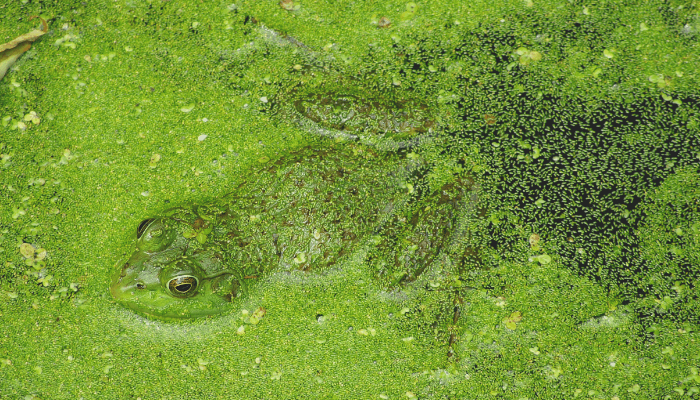
Colour: Bright green to dark green. Free-floating variety turns entire pool water green, wall-clinging variety appears as green film on surfaces.
Texture: Slimy film on surfaces. Free-floating green algae creates uniform cloudiness throughout water volume.
Location: Everywhere = walls, floor, water column, steps. Unlike mustard algae, green algae grows in sun-exposed areas as readily as shaded zones.
Smell: Earthy, pond-like odour.
Speed: Green algae can turn a pool completely green within 24-48 hours under ideal conditions (warm water, sunlight, low or absent chlorine).
Classification
Over 20,000 green algae species exist (Chlorophyta division). Common pool-affecting species include Cladophora, Spirogyra, and single-celled species forming green water cloudiness. All require light for photosynthesis, dissolved nitrogen and phosphorus for growth.
Chlorine Resistance
Low to moderate: Standard maintenance chlorine (1-3 ppm) insufficient once bloom is established. Requires double shock (20 ppm free chlorine) for established blooms. Most manageable with regular maintenance preventing establishment.
Health Risks
Moderate: Green algae harbours bacteria (E. coli, Pseudomonas, Giardia, Cryptosporidium) in biofilm layers. Reduced visibility (cloudy green water) creates drowning risk where people cannot see pool bottom or a swimmer in distress.
Treatment
- Brush all surfaces
- Test and adjust pH 7.2-7.4
- Double shock: 20 ppm free chlorine (2× normal dose)
- Run pump 24 hours
- Brush again after 12 hours
- Backwash or clean filter
- Vacuum to waste once algae dies (turns grey/brown)
- Test chemistry, balance, maintain 2-3 ppm free chlorine
Timeline: 24-72 hours for mild to moderate bloom. Severe green water bloom may take 3-5 days.
Mustard Algae (Yellow Algae)
Identification
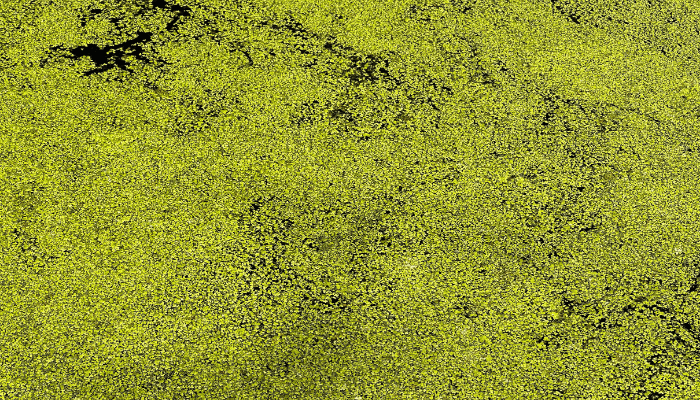
Colour: Yellow, mustard-yellow, tan, or brownish. Under direct light, bright yellow-green.
Texture: Distinctly powdery or dusty. Brushes off the surface easily and that is the defining characteristic. Unlike green algae slime, mustard algae feels dry and loose.
Location: Shaded walls, corners, behind steps and ladders, low-circulation zones. Rarely found on sun-exposed floor sections.
Reforming: Returns to the same locations within 24-48 hours of brushing. If a yellow deposit reappears repeatedly in the same spot after brushing, it is almost certainly mustard algae.
Classification: Phaeophyta family (yellow-green/brown algae group). Distinct genetics from green algae. They have a different cell structure, different chlorine resistance mechanisms.
Chlorine Resistance
High: Cellular adaptations reduce chlorine penetration. Standard maintenance chlorine bleaches surface layers while the inner colony survives. Standard 20 ppm green algae shock treatment is often insufficient.
Health Risks
Moderate: Not directly harmful but harbours bacteria. Safer than severe green algae blooms in terms of direct swimmer risk, but should not swim in visibly affected water.
Treatment
- Test water, lower CYA if above 80 ppm (partial drain and refill)
- Adjust pH 7.2-7.4
- Brush all surfaces thoroughly
- Apply mustard-specific algaecide (Yellow Out, Yellow Treat, copper algaecide)
- Wait 5-10 minutes, then triple shock: 30+ ppm free chlorine
- Run pump 24 hours
- Brush again
- Decontaminate all accessories (bleach wash swimsuits, chlorine soak pool tools)
- Decontaminate or replace filter media
- Vacuum to waste
- Re-shock following morning
- Maintain 3-5 ppm free chlorine for one week
Timeline: 3-5 days minimum. Recurrence common without complete accessory and filter decontamination.
Black Algae
Identification
Colour: Dark blue-green to black spots. May appear navy, dark green, or true black depending on species and density.
Texture: Rough, firmly attached spots. Resists brushing and requires aggressive wire brush (concrete pools only) or stiff nylon brush (fiberglass, vinyl) to disturb. Does not brush off like mustard algae.
Location: Almost exclusively on concrete, gunite, or plaster surfaces. Porous surface material allows root system penetration. Rare in fiberglass or vinyl liner pools which lack porous substrate.
Size: Spots typically 0.5-3 cm diameter. Multiple spots may merge into larger colonies over time.
Root system: Penetrates porous concrete to depth of 0.5-2 cm, anchoring organisms and protecting inner cells from chemical treatment at surface.
Classification
Black algae belongs to the cyanobacteria group (Cyanobacteria, blue-green algae). Technically bacteria, not true algae, but universally referred to as black algae in the pool industry. Forms protective outer layer of hardened cellular material resisting chemical penetration.
Chlorine Resistance
Very high: Protective waxy outer layer prevents chlorine penetration. Triple shock at 30+ ppm destroys surface cells but inner root cells survive. Requires sustained elevated chlorine over multiple weeks combined with repeated aggressive physical brushing to break through the protective layer.
Health Risks
Moderate to high: Cyanobacteria produce toxins (cyanotoxins) in some species, though pool concentrations are typically below harmful thresholds. Rough surface spots create skin abrasion hazards. Black algae harbours pathogenic bacteria in extensive biofilm. Do not swim while black algae is actively present.
Surface damage: Root penetration damages pool plaster, etches concrete, and can cause structural pitting over time if left untreated. Staining is often permanent even after algae is killed.
Treatment
Treatment takes weeks not days and it’s the most difficult pool algae to fully eliminate.
- Adjust pH 7.2-7.4
- Aggressive wire-brush scrubbing: Use wire brush on concrete/plaster to break through the outer protective layer. Physical disruption is essential – chemicals cannot penetrate an undamaged surface layer. Wire brush leaves scratch marks on plaster – unavoidable.
- Apply targeted concentrated chlorine directly to each spot: granular shock placed directly on wet brush tip, then scrubbed onto each black algae spot individually. Trichlor tablets rubbed directly on spots were also effective.
- Triple shock pool: 30+ ppm
- Run pump continuously 24-48 hours
- Brush every 24 hours – each brushing breaks newly regenerated protective layer
- Repeat shock every 48 hours until spots no longer return after brushing
- Decontaminate filter completely
- Apply copper-based algaecide as supplemental treatment after chlorine drops to normal range
Timeline: 2-4 weeks of sustained treatment. If black algae recurs after multiple treatment cycles, acid washing or pool replastering may be required.
Fiberglass/vinyl: Black algae rare in these pool types. If spots appear, use nylon brush only. Black-appearing spots on fiberglass may be metal staining or mould rather than true black algae.
Pink Slime (Pink Algae)
Identification
Colour: Pink, salmon, coral, or light red slimy growth.
Texture: Slimy, wet appearance. More viscous and gel-like than algae deposits.
Location: Low-circulation areas – behind ladder bases, under skimmer lids, inside return jet bodies, at waterline corners, on PVC plumbing and accessories. Strong affinity for PVC plastic surfaces.
Classification: Not true algae. Serratia marcescens or Methylobacterium species are bacteria, not algae. The “pink algae” name is a widespread misnomer. Often co-occurs with white water mould.
Chlorine Resistance
High: Bacterial biofilm provides significant protection from chlorine. Standard maintenance doses are insufficient once established.
Health Risks
High – greatest health concern of all pool “algae” types. Serratia marcescens is an opportunistic pathogen causing:
- Urinary tract infections (UTI), particularly from contaminated water exposure
- Wound infections through cuts or abrasions
- Respiratory infections from inhaled aerosolised water
- Eye infections from direct water contact
Immunocompromised individuals, elderly, and people with open wounds at significantly elevated risk.
Treatment
- Turn off pump
- Apply pink bacteria-specific biocide or algaecide (products labelled specifically for pink slime/bacteria – generic green algaecides less effective)
- Wait 24 hours without circulating
- Triple or quadruple shock pool
- Run pump 24 hours
- Scrub all surfaces, PVC fittings, skimmer interior
- Decontaminate all accessories
- Decontaminate filter completely
- Maintain free chlorine 5 ppm for one week
- Address co-occurring white water mould simultaneously
Timeline: 3-7 days for initial control. Recurrence common without sustained elevated chlorine.
White Water Mould
Identification
Colour: White, grey, off-white.
Texture: Slimy, slightly stringy. Free-floating pieces resemble wet tissue paper or soggy cotton. Slimy film on surfaces.
Location: Surfaces in low-circulation areas, inside skimmer, coating hoses, filter media, return jet bodies.
Classification: Saprolegnia spp. is an oomycete organism (water mould). Not true algae, not fungus. More closely related to brown algae than to fungi genetically.
Chlorine Resistance
Very high: Protective biofilm composed of cellulose, glucans, and chitin resists standard and even double-strength chlorine. Requires triple to quadruple shock (30-40 ppm).
Health Risks
Low direct, moderate indirect: White water mould itself is not a human pathogen. Almost always co-occurs with pink slime which is pathogenic. Combined infection requires simultaneous treatment of both organisms.
Treatment
- Brush all surfaces
- Apply yellow algaecide or copper algaecide (aids penetration of biofilm)
- Triple/quadruple shock: 30-40 ppm
- Simultaneously apply pink slime biocide if pink slime present
- Decontaminate all accessories
- Complete filter decontamination or media replacement
- Maintain free chlorine 3-5 ppm for one week
Timeline: 5-10 days for complete elimination.
Algae Comparison Summary
Treatment Difficulty Ranking (Easiest to Hardest)
- Green algae – double shock, 1-3 days
- Pink slime – specific biocide + triple shock, 3-7 days
- White water mould – triple/quadruple shock, 5-10 days
- Mustard algae – algaecide + triple shock + accessory decontamination, 3-7 days
- Black algae – sustained treatment 2-4 weeks, may require replastering
Chlorine Resistance Comparison
Green algae: Low-moderate. Double shock (20 ppm) effective.
Mustard algae: High. Requires algaecide pre-treatment plus triple shock (30 ppm).
Black algae: Very high. Requires physical disruption plus concentrated direct application plus repeated shocking over weeks.
Pink slime: High. Requires specific biocide, chlorine shock secondary.
White water mould: Very high. Triple to quadruple shock (30-40 ppm) required.
Critical Difference: Filter Decontamination
All algae types (and white water mould, pink slime) colonise filter media – sand grains, cartridge pleats, DE grids. Any treatment cleaning the pool but leaving filter media untreated results in immediate re-infection from the filter. Decontaminate or replace filter media as part of every algae treatment protocol regardless of type.
Common Conditions Across All Algae Types
Why All Algae Establish
Low free chlorine: Primary condition. Chlorine below 1 ppm allows even the least resistant green algae to establish within hours.
High cyanuric acid: CYA above 80 ppm reduces effective chlorine activity dramatically. Pool may test adequate free chlorine (3 ppm) but chlorine biologically ineffective at high CYA – creates false security while algae establishes.
Poor circulation: Stagnant zones develop chlorine-deficient microenvironments. All algae types prefer areas of low flow. Mustard and black algae are particularly associated with low-circulation areas.
Warm water and sunlight: Algae growth rates increase exponentially with temperature. Every 10°C increase in water temperature approximately doubles algae growth rate.
Organic load: Nutrients (nitrogen, phosphorus from swimmer waste, leaves, pollen, debris) required for algae growth. High organic input overwhelms sanitisers.
Universal Prevention Measures
Maintain free chlorine 2-3 ppm: Non-negotiable foundation. Test 1-2 times weekly during the season.
CYA 30-50 ppm: Protects chlorine from UV without over-stabilising.
Run pump 8-10 hours daily minimum: Eliminates dead zones.
Brush weekly: Dislodges establishing algae before visible growth. Focus on low-circulation, shaded areas first.
Skim and vacuum regularly: Removes organic matter reducing algae nutrient supply.
Shock after heavy use or rain: Bather waste and rainwater dilution deplete chlorine. Make sure to shock within 24 hours.
Clean filter on schedule: Clogged filter reduces circulation, increases dead zones.
Natural Swimming Pools: No Algae Without Chemicals
Natural swimming pools prevent all conventional pool algae types through ecological balance rather than chemical treatment. It’s the principle of governing healthy lakes, rivers, and natural swimming environments.
Nutrient competition: Aquatic plants (Typha, Phragmites, Juncus, Iris) in regeneration zones absorb dissolved nitrogen and phosphorus through extensive root systems continuously. Without adequate nutrient supply, all algae types like green, mustard, black, and others cannot sustain colony growth regardless of other conditions.
No chlorine vulnerabilities: Natural pools contain no cyanuric acid complications, no chlorine management gaps, no chemical imbalances creating treatment windows. The entire category of “low chlorine allowing algae” is absent.
Biological competition: Dense beneficial bacterial communities in gravel substrate and plant root zones occupy ecological niches and consume organic matter before algae can exploit it. Competition for resources prevents pathogenic organisms and nuisance algae dominance.
Continuous biological activity: Biological filtration operates 24 hours daily as water circulates through planted zones. There are no rest periods or chemical depletion windows where algae can establish.
Separation of zones: Swimming zone remains physically separated from planted regeneration zone. Even if beneficial algae (naturally present at low levels in healthy water) exists, controlled biological balance prevents any single type from blooming to problematic concentrations.
Oásis Biosistema designs natural swimming pools using planted regeneration zones where continuous nutrient absorption by aquatic plants and beneficial bacterial competition prevent green, mustard, black, and other algae types from establishing, eliminating the repeated treatment cycles, chemical costs, and filter media replacement associated with algae management in conventional chemical pools.
Conclusion
Swimming pools develop five main problematic growth types: green algae (most common, double shock 20 ppm, 1-3 days treatment), mustard algae (yellow dusty deposits, chlorine resistant, algaecide + triple shock 30 ppm, full accessory decontamination required), black algae (hardest, deep-rooted in concrete, 2-4 weeks of wire brushing and repeated shocking), pink slime (Serratia marcescens bacteria, genuine health risk causing UTI and wound infections, specific biocide required), and white water mould (Saprolegnia, oomycete not true algae, triple/quadruple shock required, almost always co-occurring with pink slime). All types require filter media decontamination or replacement and accessory cleaning to prevent re-seeding after surface treatment.
Natural swimming pools designed by Oásis Biosistema eliminate all conventional algae management through nutrient competition in planted regeneration zones where aquatic plants continuously absorb nitrogen and phosphorus preventing any algae type from establishing in chemical-free Portuguese pool installations.
FAQ
How do I know what type of algae is in my pool?
You can usually identify algae by color and where it grows. Green algae makes water cloudy or green and spreads fast. Yellow or mustard algae looks dusty on walls. Black algae forms dark spots with deep roots. A simple test is brushing a spot. If it clouds the water, it’s most likely algae.
Can I swim in a pool that has algae in it?
It’s not recommended to swim in any pool with visible algae. Algae indicates poor sanitation and low chlorine levels, which can also allow bacteria to grow. It may cause skin or eye irritation and slippery surfaces, increasing accident risk.
What are the 4 types of algae?
The main pool-related algae types are:
- Green algae (most common, fast-growing)
- Yellow or mustard algae (chlorine-resistant, powdery)
- Black algae (stubborn, root-forming spots)
- Pink algae (actually a bacteria-like organism, slimy biofilm)
What clears up algae in a pool?
To clear algae, you need a combination of brushing, filtration, and strong sanitization. Shock the pool with chlorine, run the pump continuously, clean or backwash the filter, and brush all surfaces. For stubborn types like black or mustard algae, repeated treatment or algaecide may be required.