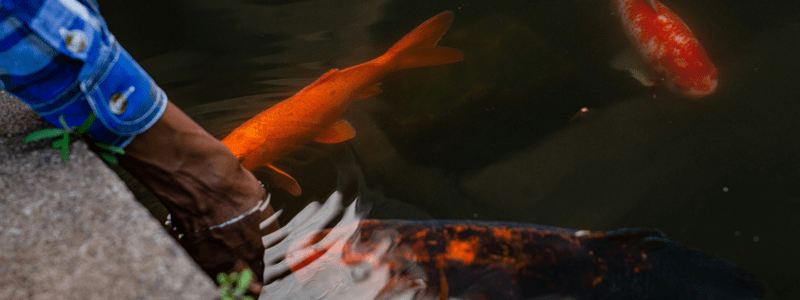
Koi fish display an extraordinary range of colors and patterns from pure white to deep black, vibrant reds to metallic golds, serene blues to striking tri-color combinations. These colors aren’t random; they’re the result of centuries of selective breeding in Japan, where koi culture transformed practical carp into living works of art. Each color variety has specific characteristics that determine its classification, quality, and value, and many carry cultural symbolism rooted in Japanese tradition.
Understanding koi colors helps you identify different varieties, assess fish quality, choose koi that complement your pond’s aesthetic, and appreciate the cultural meanings these beautiful fish carry. This guide covers the primary colors found in koi, how they combine to create recognized varieties, what determines color quality, and the symbolism associated with different hues and patterns.
Key Takeaways
- Three fundamental colors form the basis of most koi varieties: Hi (red), Shiro (white), and Sumi (black).
- Additional colors include Ki (yellow), Cha (brown/tea), Ai (blue/indigo), and metallic variations (gold, platinum, silver).
- The Gosanke like Kohaku (white with red), Sanke (white with red and black), and Showa (black with red and white), are the most prestigious varieties and command the highest prices for exceptional specimens.
- Color quality factors: Intensity (deep, vibrant hues), boundary definition (sharp edges between colors), placement and balance (symmetry and distribution), and base color purity (especially white).
- Cultural symbolism: Red represents love and strength, white symbolizes purity, black signifies perseverance, gold means prosperity, and blue conveys peace and tranquility.
- Pattern matters as much as color. Two koi with identical colors can have vastly different values based on how those colors are arranged and balanced.
Give Your Koi a Pond Worth Showing Off
The Three Core Colors: Hi, Shiro, and Sumi
Most koi varieties are built from combinations of three fundamental colors. Understanding these basics helps you comprehend how the hundreds of recognized varieties are classified.
Hi (Red/Orange-Red)
Hi is the Japanese term for red or orange-red coloration in koi. This is the most important color in many prestigious varieties, particularly the Gosanke.
Quality characteristics:
- Depth: The best Hi is deep, saturated crimson that appears three-dimensional rather than flat
- Uniformity: Consistent color intensity throughout the red areas, without pale patches or uneven pigmentation
- Stability: Hi that maintains vibrancy as the koi ages (some koi lose color intensity over time)
- Edge definition (kiwa): Sharp, clean boundaries where red meets white or other colors
Varieties featuring Hi as primary color:
- Kohaku (red on white base)
- Tancho (single red circle on head)
- Hi Utsuri (red on black base)
- Sanke and Showa (red as one of three colors)
The quality and placement of Hi patterns is the single most critical factor in judging Gosanke varieties. A Kohaku with exceptional Hi and pattern can be worth tens of thousands of euros; one with weak, poorly-placed Hi might be worth €20.
Shiro (White)
Shiro refers to the white base color that serves as the canvas for patterns in many koi varieties. Pure, unblemished white is extraordinarily difficult to breed and maintain.
Quality characteristics:
- Purity: Snow-white with no yellow, cream, or grey tints
- Consistency: Uniform whiteness across the entire body
- Clarity: No staining, discoloration, or shimmer interference (unless Gin Rin variety)
Importance of Shiro:
In Gosanke varieties (Kohaku, Sanke, Showa), the white serves as a negative space that makes colored patterns stand out. Impure or discolored white dramatically reduces fish value. A Kohaku with yellowish white will never be show-quality regardless of how beautiful its red pattern is.
Think of Shiro as a blank canvas in painting. A brilliant artwork on stained, yellowed canvas loses impact; the same artwork on pure white canvas shines.
Sumi (Black)
Sumi is the black coloration found in varieties like Sanke, Showa, Utsuri, and Bekko.
Quality characteristics:
- Depth: Deep, lacquer-like black (not grey or faded)
- Clarity: Well-defined edges, not blurred or muddy
- Stability: Sumi that remains solid as koi ages (some koi develop or lose Sumi over time)
- Placement: Strategically positioned to balance other colors
Important distinction:
In Sanke, Sumi appears primarily on the back and doesn’t extend below the lateral line or onto the head (except in modern varieties). In Showa, Sumi is the base color with extensive coverage including head, body, and below the lateral line.
This difference in Sumi pattern distinguishes Sanke from Showa. They’re both tri-color koi, but the role and distribution of black differs fundamentally.
Additional Colors in Koi
Beyond the three core colors, koi breeding has produced many other hues through genetic selection and mutation.
Ki (Yellow)
Ki is yellow coloration ranging from pale lemon to deep mustard or gold.
Varieties featuring Ki:
- Kigoi (solid yellow)
- Ki Utsuri (yellow on black base)
- Yamabuki Ogon (metallic yellow)
- Ki Bekko (yellow with black spots)
Quality Ki is vibrant and consistent, not washed-out or patchy. In metallic varieties (Ogon), Ki should have brilliant lustre.
Cha (Brown/Tea)
Cha refers to brown or tea-colored koi. This is less common and generally not as highly valued as other colors in traditional koi circles.
Varieties featuring Cha:
- Chagoi (solid brown, valued for docile temperament rather than color)
- Ochiba Shigure (grey-blue with brown/yellow patterns, name means “autumn leaves on water”)
While not prestigious for shows, Chagoi are extremely popular pond fish because they’re friendly, grow large, and calm other koi.
Ai (Blue/Indigo)
Ai is blue or indigo coloration, typically appearing as a blue-grey in Asagi and Shusui varieties or as a netted pattern overlay in Koromo varieties.
Varieties featuring Ai:
- Asagi (pale blue back with red belly/fins)
- Shusui (scaleless version of Asagi)
- Koromo varieties (blue/indigo netted pattern over red)
Quality Ai is soft, even blue-grey without brown or muddy tones. In Asagi/Shusui, the blue back should be uniform; in Koromo, the blue netting should be clearly defined over red.
Metallic Colors (Ogon)
Metallic koi have reflective, shimmering scales that create a lustrous appearance. These aren’t technically separate colors but rather modifications of base colors.
Metallic varieties:
- Yamabuki Ogon (metallic yellow/gold)
- Platinum Ogon (metallic white/silver)
- Orenji Ogon (metallic orange)
- Matsuba (metallic with pinecone scale pattern)
Metallic koi divide opinions. They’re popular in western countries (including Portugal, UK, US) for their eye-catching shimmer, but traditional Japanese collectors often prefer non-metallic varieties for their subtlety and refinement.
Major Koi Varieties by Color Pattern
Gosanke: The “Big Three”
The Gosanke (Kohaku, Sanke, and Showa) are the most prestigious and valuable koi varieties. Mastery of these three represents the pinnacle of koi breeding.
Kohaku (White with Red)
Description: Pure white body (Shiro) with red patterns (Hi). No other colors present.
Pattern variations:
- Nidan (two-step) – Two distinct red patterns
- Sandan (three-step) – Three distinct red patterns
- Yondan (four-step) – Four distinct red patterns
- Inazuma (lightning) – Continuous zigzag red pattern from head to tail
- Tancho – Single red circle on head only (resembles Japanese flag)
Quality factors:
- Pure white base with no yellow or grey tones
- Deep, vibrant red with sharp, clean edges
- Balanced pattern distribution (not all crowded at one end)
- Pattern typically starts at or near head and flows toward tail
Cultural meaning: Kohaku symbolizes purity, success, and a bright future. The clean white represents life free of burdens; the red represents passion and vitality.
Sanke (Taisho Sanshoku)
Description: White base with red and black markings. Black (Sumi) appears as distinct spots, primarily on the back above the lateral line.
Distinguishing characteristics:
- White is the base color (visible under the fish)
- Red patterns similar to Kohaku
- Black appears as supplementary accent (usually not on head in traditional Sanke)
- Black doesn’t extend significantly below lateral line
Quality factors:
- All Kohaku quality standards apply (white purity, red intensity and placement)
- Black should be deep lacquer-black, not grey
- Black spots should be balanced across the body
- Ideally, black doesn’t break up red patterns but complements them
Cultural meaning: Sanke combines white (purity), red (strength and love), and black (overcoming adversity). The three colors together represent strength through life’s challenges.
Showa (Showa Sanshoku)
Description: Black base color with red and white patterns. This is fundamentally different from Sanke as black is the foundation, not an accent.
Distinguishing characteristics:
- Black is the base color (visible under the fish if you could look beneath)
- Extensive black coverage including head (typically lightning-bolt shaped black on head)
- Black extends below lateral line and onto fins
- White and red appear as patterns against the black background
Quality factors:
- Deep, solid black (Sumi) throughout
- Vibrant red (Hi) that contrasts sharply with black
- Pure white (Shiro) areas
- Balanced distribution of all three colors (none dominating excessively)
- Modern Showa often have more white than traditional versions (called “Kindai Showa”)
Cultural meaning: Showa represents balance between opposing forces — light and dark, good and evil, struggle and triumph. Black symbolizes perseverance through difficulty.
Utsuri Varieties (Two-Color on Black Base)
Utsuri koi have a black base with one other color creating patterns.
Shiro Utsuri: Black with white patterns. These are essentially Showa without the red.
Hi Utsuri: Black with red patterns.
Ki Utsuri: Black with yellow patterns.
All Utsuri varieties are judged similarly to Showa. The black should be deep and extensive, with the contrasting color creating balanced, interesting patterns.
Cultural meaning: Utsuri represent transformation, balance between light and dark, and the rhythm of life’s obstacles and triumphs.
Bekko Varieties (Colored Base with Black Spots)
Bekko koi have a colored base (white, red, or yellow) with black (Sumi) spots distributed across the back.
Shiro Bekko: White with black spots
Aka Bekko: Red with black spots
Ki Bekko: Yellow with black spots
The black spots in Bekko should be crisp and well-defined, appearing primarily on the back above the lateral line. Bekko are simpler in pattern than Gosanke but still highly regarded for their understated elegance.
Cultural meaning: Bekko represent quiet strength, dependability, and subtle beauty — they don’t demand attention but reward careful observation.
Asagi and Shusui (Blue-Grey with Red)
Asagi: Pale blue-grey scales on the back creating a net-like pattern, with red (Hi) on the belly, gill plates, and fin bases.
Shusui: Doitsu (scaleless or partially scaled) version of Asagi. Blue scales appear in lines along the back; red appears on sides and fins.
These are among the oldest koi varieties, predating the Gosanke.
Quality factors:
- Uniform blue-grey coloring on back (no brown or muddy tones)
- Neat, consistent scale pattern (in Asagi)
- Vibrant red on belly and fins
- Clear head (no random red spots on head)
Cultural meaning: Asagi and Shusui symbolize tranquility, calmness, and peaceful waters. Their subdued coloring represents serenity and balance.
Ogon (Metallic Single-Color)
Ogon are single-colored metallic koi that shimmer brilliantly.
Varieties:
- Yamabuki Ogon (gold)
- Platinum Ogon (silver-white)
- Orenji Ogon (orange)
Quality factors:
- Uniform metallic sheen across entire body
- No blemishes or scale irregularities
- Consistent color saturation
Cultural meaning: Gold Ogon symbolize wealth, prosperity, and business success. Platinum Ogon represent business achievement and modern success.
Tancho
Tancho isn’t technically a separate variety but rather a pattern that can appear in Kohaku, Sanke, or Showa. It features a single red circle (Hi) on the head with no other red on the body.
Requirements for true Tancho:
- Red spot must be between the eyes (not extending to nose or past shoulders)
- Ideally circular or slightly oval (not irregular)
- No other red anywhere else on the body
Tancho is extremely prized in Japan because it resembles the national bird (tancho crane) and the Japanese flag.
Cultural meaning: Tancho represents focused success, purity of purpose, and national pride (in Japan).
What Determines Color Quality in Koi
Two koi with the same variety and similar patterns can have vastly different values based on color quality.
Color Intensity and Depth
The best koi colors are deep, saturated, and appear three-dimensional. Pale, washed-out colors indicate poor quality or poor husbandry (improper feeding, inadequate water conditions).
High-quality red: Deep crimson that looks almost glowing, not pale pink or orange
High-quality white: Pure snow-white, not cream or yellowish
High-quality black: Lacquer-black, not grey or faded
Edge Definition (Kiwa)
Kiwa refers to the edge quality where one color meets another. Sharp, clean boundaries between colors are prized. Blurred, feathered, or indistinct edges reduce value significantly.
Why edge quality matters:
Clean edges make patterns appear crisp and intentional rather than accidental. A koi with sharp kiwa looks like a carefully painted artwork; one with poor kiwa looks smudged and unfinished.
Color Placement and Balance
Colors should be distributed harmoniously across the body. Patterns that are lopsided (all on one side), crowded at one end, or leave large empty spaces are considered lower quality.
Traditional Japanese aesthetics value:
- Balance between colored and white areas (not overwhelming dominance of either)
- Patterns that flow naturally along the body’s contours
- Strategic placement that draws the eye along the koi’s length
Stability and Development
Koi colors change as fish mature. The best koi maintain or improve color intensity as they age; lesser koi fade, develop unwanted colors, or lose pattern definition.
Common color changes:
- Sumi (black) often develops or intensifies as koi mature (age 2-5 years)
- Some Hi can fade or change hue if water quality is poor
- White can yellow with age if diet is improper
Breeders and serious collectors often buy young koi (tosai) and gamble on how colors will develop. Buying mature koi eliminates this uncertainty but costs significantly more.
Color Symbolism and Cultural Meanings
Beyond classification and quality, koi colors carry symbolic meanings rooted in Japanese and broader Asian culture.
Red Koi: Love, Strength, Power
Red (Hi) symbolizes intense emotions such as love, passion, bravery, and maternal strength. In Japanese culture, red koi are often associated with feminine energy and motherhood.
Varieties emphasizing red:
- Kohaku (red and white)
- Beni Kumonryu (solid red with black)
- Hi Utsuri (red and black)
White Koi: Purity, New Beginnings
White (Shiro) represents purity, cleanliness, and new beginnings. It’s a blank slate free from past burdens.
Varieties emphasizing white:
- Platinum Ogon (metallic white)
- Shiro Utsuri (white and black)
Black Koi: Perseverance, Overcoming Adversity
Black (Sumi) symbolizes resilience, transformation, and triumph over hardship. Black koi represent the journey through difficult times and emerging stronger.
Varieties emphasizing black:
- Karasu (solid black)
- Kumonryu (black that changes patterns)
- Showa (black with red and white)
The legend of koi swimming upstream to become dragons is often illustrated with black koi and the struggle through adversity leading to transformation.
Gold Koi: Wealth, Prosperity
Gold and metallic koi symbolize financial success, business prosperity, and material wealth.
Varieties:
- Yamabuki Ogon (gold)
- Kin variants (gold overlays on other patterns)
Blue Koi: Peace, Tranquility, Masculinity
Blue-grey koi represent calmness, serenity, and emotional balance. In Japanese culture, blue koi are sometimes associated with masculine energy and the role of the father.
Varieties:
- Asagi (blue-grey and red)
- Shusui (blue-grey and red)
Yellow Koi: Friendship, Optimism
Yellow (Ki) represents joy, friendship, optimism, the brightness of sunlight and positive energy.
Varieties:
- Kigoi (solid yellow)
- Yamabuki Ogon (metallic yellow)
Choosing Koi Colors for Your Pond
Aesthetic Considerations
Contrast with pond surroundings:
- Dark ponds (black liner, deep water) make white, red, and metallic koi highly visible
- Light-colored ponds (natural stone, light liner) showcase Asagi, Shusui, and darker varieties better
- Planted ponds benefit from bold colors (Kohaku, Ogon) that stand out against greenery
Color harmony:
- Monochromatic collections (all Gosanke, all Ogon) create visual unity
- Diverse collections (mix of varieties) create visual interest and showcase range
- Avoid too many competing patterns as a pond with 20 different varieties can look chaotic
Practical Considerations
Water conditions affect color:
- Poor water quality dulls colors, particularly red and white
- High nitrate levels can cause white to yellow
- Improper diet affects color intensity (especially red and yellow)
Portugal’s climate and koi colors:
Portugal’s hot, sunny summers benefit koi coloration. Sunlight enhances red and yellow pigmentation. However, intense UV can fade some colors if ponds lack adequate depth or shade. Ponds with mixed sun/shade exposure typically showcase koi colors best.
Visibility from viewing angle:
If you primarily view your pond from above (standing at edge), bold patterns like Kohaku and Ogon are most striking. If you view from the side (through viewing windows or shallow edges), Asagi, Shusui, and Utsuri varieties that have interesting side patterns are excellent choices.
Natural Pools and Koi: A Note on Compatibility
While this guide focuses on koi color varieties for ornamental ponds, it’s important to understand that natural swimming pools and koi ponds have fundamentally incompatible design philosophies.
Natural pools prioritize human swimming and use biological filtration through dense aquatic plant zones. These planted areas create nutrient fluctuations and low visibility unsuitable for koi. Koi need stable water chemistry and clear water for visual appreciation, and they consume most aquatic plants.
However, separate but connected systems can work: a dedicated koi pond with mechanical filtration linked to a natural wetland filtration zone that provides additional biological processing without the dense vegetation interfering with koi viewing.
If you’re planning comprehensive water features that might include both ornamental fish and swimming areas, understanding the requirements of each helps create designs where both can coexist successfully in separate but integrated zones.
Oásis Biosistema specializes in natural pool design and understands aquatic ecosystem management. While koi ponds aren’t natural pools, the principles of water quality, biological balance, and aesthetic integration apply across all water feature types.
Conclusion
Koi fish colors range from the pure fundamental white, red, and black, through yellows, blues, browns, and metallic variations, creating hundreds of recognized varieties through different combinations and patterns. Understanding these colors helps you identify varieties, appreciate quality differences, choose koi that complement your pond, and connect with the cultural meanings these fish carry.
The Gosanke varieties (Kohaku, Sanke, Showa) built from white, red, and black remain the most prestigious and challenging to perfect, representing the pinnacle of koi breeding artistry. But every variety, from humble Chagoi to brilliant Ogon to serene Asagi, has its place and appeal.
Choose koi colors based on what resonates with you personally, what complements your pond environment, and what fits your budget and goals. A €30 domestic Kohaku with decent color can bring as much daily enjoyment as a €3,000 Japanese import if you appreciate it for what it is rather than comparing it to what it isn’t.
The beauty of koi keeping is that quality exists at every price point. You just need to understand what you’re looking at and what makes it valuable at its level.
FAQ
What are the colors of a koi fish?
Koi fish come in a wide range of colors, including white, red, orange, yellow, black, blue, and cream. Many varieties feature striking combinations and patterns, such as red and white or black with orange, making koi highly prized for their unique appearance.
What color koi is most valuable?
Red and white koi, especially the Kohaku variety, are often the most valuable when they have clean, well-balanced patterns and strong color contrast. High-quality black, tri-color, or metallic koi can also be very valuable depending on rarity and pattern quality.
What is the most beautiful koi?
Beauty in koi is subjective, but Kohaku, Taisho Sanke, and Showa varieties are often considered the most beautiful. These koi are prized for their balanced patterns, vibrant colors, and symmetry, which are key factors in competitions and collector value.
Do koi fish come in purple?
True purple koi do not naturally exist. However, some koi may appear slightly purplish due to lighting, water conditions, or color blending. Breeders have not developed a stable, naturally purple koi variety, so it is not considered a standard color.